
A dual-sensor payload without smart display modes is two cameras taped together. PiP, fusion overlays and synchronised capture are what turn aligned channels into a single operational picture.
- 2 channelsThermal and visible
- 1 pictureWhat the modes create
- Pre-sortieWhen to pick the mode
- CosmeticWhat fusion does to data
Key takeaways
- Picture-in-picture keeps orientation while you scan for heat — the default for search and patrol.
- Fusion restores structure that pure thermal flattens, which helps navigation and hinders measurement.
- Synchronised capture of both channels with matched timestamps is the reporting workflow: finding plus cause in one pass.
- Pick the mode before the sortie. Mode-surfing mid-task is where targets get lost.
On this page
Why Display Modes Are the Real Feature
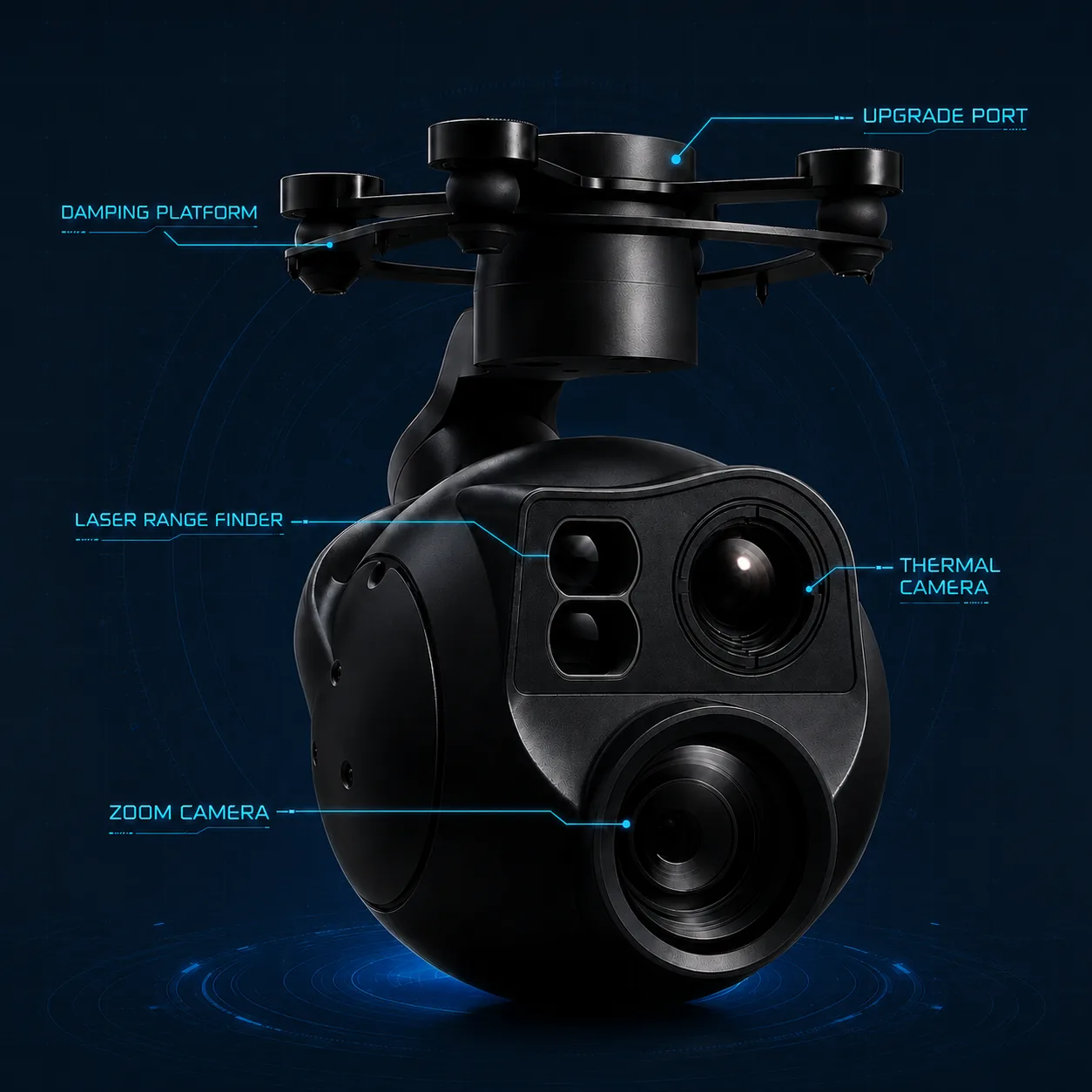
Buying a dual-sensor payload gets you two aligned channels. What makes them worth more than two separate cameras is the set of modes that present them as one picture — and the alignment underneath that makes those modes possible at all.
That alignment is not free. Factory boresight calibration is what guarantees a point in the thermal frame corresponds to the same point in the visible frame, and without it every overlay is subtly wrong in a way that gets worse toward the frame edges. EO/IR sensor fusion and boresight alignment covers how it is established and held.
It is also what separates a multi-sensor pod from field-swapped cameras — see one multi-sensor payload or several cameras.
Picture-in-Picture: Context Plus Focus
Thermal main with a visible inset, or the reverse, keeps orientation while you scan for heat. This is the default for search and patrol work, and the reason is cognitive rather than technical: pure thermal flattens a scene into temperature, and an operator sweeping unfamiliar terrain loses track of where they are.
The inset answers “what am I actually looking at?” without a mode switch. That matters during an active search, where the two seconds spent toggling modes is two seconds not watching the feed — and where the toggle itself resets the operator’s visual adaptation.
For SAR sweeps and night patrol, PiP with thermal as the main channel is the sensible standing configuration.
Fusion and Edge Overlay
Blending visible edges onto the thermal image restores structure that pure thermal flattens — panel outlines on a solar field, roof seams, fence lines, the boundary between one bay and the next. Navigating a structured scene in pure thermal is genuinely hard, and edge overlay fixes it directly.
Switch it off for measurement. Overlaid edges bias perception: a hot region bounded by a visible seam reads as conforming to that seam whether or not it does, and an operator grading severity is now influenced by a cosmetic layer. For radiometric work the discipline is to navigate in fusion and measure in plain thermal.
This is the same class of perceptual trap as palette choice, covered in thermal palettes compared — the display is helping you notice things, and it can help you notice things that are not there.
Split and Synchronised Capture
Recording both channels simultaneously with matched timestamps is the reporting workflow. A thermal finding plus visible cause evidence, captured in one pass, is what turns a survey into a document somebody can act on — the loop described in the complete guide to drone inspections.
Timestamp matching is the part that matters and the part that is easy to assume. Two streams recorded independently drift, and a report pairing a thermal frame with a visible frame from a slightly different moment is quietly wrong. Multi-sensor time synchronisation covers how frame alignment is maintained inside the payload.
| Mode | Best for | Avoid when | Typical mission |
|---|---|---|---|
| Picture-in-picture | Keeping orientation while scanning thermal | Detail work at high zoom | Search, patrol, overwatch |
| Fusion / edge overlay | Navigating structured scenes | Grading severity or measuring | Solar, roof, facade inspection |
| Split view | Comparing channels side by side | Small screens | Training, debrief, confirmation |
| Synchronised capture | Evidence pairing for reports | Nothing — record it by default | All inspection reporting |
| Single channel | Measurement and severity grading | Wide-area orientation | Radiometric analysis |
Operator Discipline
Pick the mode before the sortie, not during the approach. Mode-surfing mid-task is where targets get lost — every switch costs a moment of reorientation, and those moments accumulate at exactly the point in a mission when attention is scarcest.
Train the two-step: detect in thermal, confirm in visible, then act. That sequence is deliberately boring and it is what stops an operator acting on a heat signature that turns out to be a compost heap. Law enforcement search work depends on it as a safety practice rather than a preference.
The related habit is deciding in advance which channel is primary for the mission at hand. Thermal primary for detection work, visible primary for documentation, and a deliberate rather than reflexive switch between them.
Which Payloads Offer Dual-Channel Modes
Dual- and multi-sensor models across the range carry these capabilities, from the 110 g micro pods up to the large multi-sensor units.
| Payload | Weight | Thermal | Visible |
|---|---|---|---|
| MV-2M | 110 g | 256×192 | 3840×2160, 8.29 MP |
| MV-2P | 130 g | 640×512 | 3840×2160, 8.29 MP |
| OP-90A | Pod 608 g | 640×512 | 1920×1080, 10x optical |
| OP-90P | 620 g | 640×512 | 3840×2160, 10x optical |
| OP-125A | 1,055 g | 640×512 | 2688×1520, 30x optical |
| LX-9B | 1,158 g | 640×512 | 2688×1520, 30x optical |
Alignment is what you are paying for. Two channels in one housing are not automatically fused. Ask whether the boresight alignment is factory-calibrated and how it is verified — that is the difference between real dual-channel modes and two feeds sharing a gimbal.
Related reading
- EO/IR Sensor Fusion and Boresight Alignment
- Multi-Sensor Time Synchronization
- One Multi-Sensor Payload or Several Cameras?
- Thermal Palettes: White Hot, Black Hot and Ironbow
- The Complete Guide to Drone Inspections
- Radiometric vs Non-Radiometric Thermal
- AI Target Tracking on UAV Payloads
- Search Patterns for Thermal Drone SAR
- MV-2P — 640×512 thermal at 130 g
- OP-125A — 30x optical multi-sensor pod
- LX-9B — multi-sensor pod with ranging
- Solar Farm Thermal Inspection
FAQ
Does fusion change radiometric data?
No. Display fusion is cosmetic, and recorded radiometric streams stay pure on properly designed payloads — the temperature values per pixel are stored independently of whatever the screen is showing. That said, switch fusion off when grading severity: overlaid visible edges bias how an operator reads the extent of a hot region, even though the underlying data is untouched.
Which UAVThermal payloads offer dual-channel modes?
Dual- and multi-sensor models across the range, from the MV-2M and MV-2P micro pods through the OP-90 series to the LX-9B and OP-125A. The capability depends on having two factory-aligned channels in one housing, so single-sensor pods cannot provide it regardless of firmware. Ask specifically how boresight alignment is calibrated and verified.
Should thermal or visible be the main channel in PiP?
Thermal as main for detection work, visible as main for documentation. The main channel should be the one carrying the information you are actively hunting for, with the inset supplying context. Decide it before the sortie and hold it — switching primary channel mid-task is the most disorienting of all the mode changes available to you.
Questions about the technology? Talk to our engineers — we reply within 2 business days.