

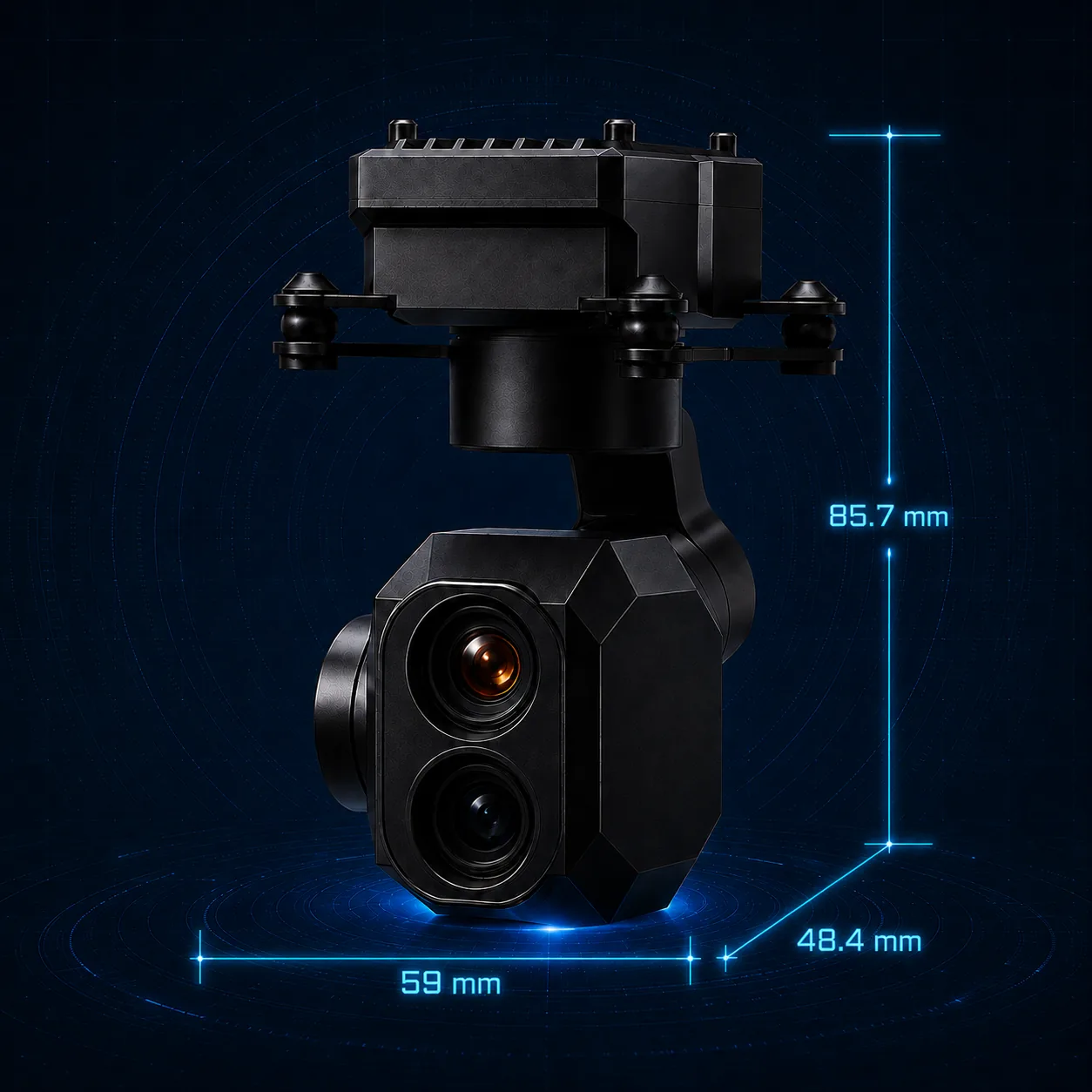
A thermal drone counts a pastured herd in minutes at night, finds the missing animal in the treeline, and flags the cow that wandered off to calve — chores that otherwise consume hours of quad-bike time.
- 110 gLightest dual-sensor option
- 640×512Thermal resolution on MV-2P
- 60–80 mTypical non-disturbing altitude
- <40 mKBest published NETD in the line
Key takeaways
- Night is the productive window: stock are settled, solar loading has dissipated, and animal-to-ground contrast peaks.
- Thermal flags outlier body-surface temperatures for follow-up. Coat, moisture and sun loading confound absolute readings — screening cue, not diagnosis.
- Payload choice tracks paddock size: MV-2M for light aircraft and close checks, MV-2P for larger paddocks and longer standoff, MV-4X when night identification matters.
- A wet newborn calf is one of the strongest small thermal targets on a ranch, usually visible within its first hours even under cover.
On this page
The Core Ranch Missions
Night herd counts. Animals rest, contrast peaks, and a settled herd holds still long enough to count reliably. A pass that takes a quad bike an hour across broken ground takes a drone a few minutes at altitude, and the count is repeatable because the imagery is recorded.
Locating strays in brush and gullies. This is where thermal earns its keep. A single animal in a treeline is nearly invisible to a visual search from the ground and obvious from above in LWIR. The same logic that drives wildlife monitoring applies directly.
Calving-season perimeter checks. A cow that has separated from the herd is a signal in itself; thermal makes the separation visible across a whole paddock in one sweep rather than one gate at a time.
Predator activity monitoring around pens. Night patrols detect approach before loss, and a payload with a low-light channel lets you identify what you detected. Livestock and ranch monitoring covers the operational programme in more depth.
Health Indication — With Honest Limits
Thermal can flag outlier body-surface temperatures suggesting fever or inflammation, and that is genuinely useful as a triage cue across a large herd. What it cannot do is give you a core temperature. Coat thickness, surface moisture, recent activity and sun loading all shift the surface reading independently of the animal’s actual condition.
Treat it as a screening cue, not a diagnosis. The right output is “these six animals look different from the rest of the herd this morning, go and look at them”, not a number in a veterinary record. The confounders here are the same ones covered in emissivity in drone thermography — a wet coat and a dry coat are different emitters, and the camera does not know which it is looking at.
Compare within the frame, not against a threshold. The reliable signal is one animal reading differently from its neighbours under identical conditions. Absolute thresholds imported from indoor veterinary practice will not survive a windy morning in an open paddock.
Choosing the Payload
Paddock size and what you need to do after detection drive the choice more than anything else.
| Payload | Weight | Thermal resolution | Published NETD | Best fit |
|---|---|---|---|---|
| MV-2M | 110 g | 256×192 | <50 mK @ 25 °C | Budget-friendly herd checks on light aircraft |
| MV-2P | 130 g | 640×512 | <40 mK @ 25 °C | Larger paddocks and longer standoff |
| MV-4X | 366 g | Uncooled VOx | Not published | Adds starlight identification for night predator response |
The step from 256×192 to 640×512 is the one that changes working altitude. More pixels on target means you can fly higher and still resolve individual animals, which means fewer passes per paddock — the resolution comparison works through the arithmetic. The MV-4X adds a low-light channel, which matters when detection is not enough and you need to see whether the thing at the fence line is a dog or a coyote.
Flying the Count
The mechanics reward a little planning. Most herds ignore aircraft above 60–80 m, so plan the counting pass at altitude with a wider lens and descend only for individual checks. Descending on a settled herd to get a better look is how you turn a count into a scatter.
- Fly the counting pass after full dark, when solar loading has dissipated and the herd has settled.
- Hold 60–80 m with a wide field of view and fly consistent parallel lanes across the paddock.
- Record rather than count live — a recorded pass can be recounted, and a live count cannot be audited.
- Mark outliers and separations during review, not in flight.
- Descend only for individual checks, and only on the animals that review flagged.
Wind is the environmental factor that bites hardest. Moving air strips the surface temperature difference you are relying on, and a windy night gives a flatter image than a still one. Fog, rain and humidity limits covers the rest of the envelope; heavy rain and dense fog both cut usable range substantially.
What It Replaces, and What It Costs
The economic case is rarely about the camera. It is about the hours: a nightly perimeter check during calving, a stray search after a fence break, a count before shipping. Those tasks have a labour cost measured in hours of someone’s evening, and they get skipped when the person is tired, which is exactly when they matter.
The costs are honest and worth stating. Battery endurance limits a pass to a paddock or two, so a large property is a multi-battery operation. Cold nights reduce endurance further — see cold-weather thermal operations. And thermal will not read ear tags; identification of a specific animal still needs a visual channel or a walk. The agriculture guide covers how ranch work sits alongside irrigation and crop-stress use of the same payload.
The failure case worth naming: relying on a thermal count in dense cover. Animals under a canopy do not appear, and a count that reads low because six cows are standing under trees is worse than no count, because it starts a search that was never needed.
Related reading
- How Uncooled VOx Microbolometers Work
- Starlight and Low-Light Imaging: Seeing in 0.01 Lux Without Thermal
- Thermal Drones in Agriculture: Irrigation, Stress and Livestock
- 256×192 vs 640×512: Choosing Drone Thermal Camera Resolution
- Thermal Drone Deer Recovery: How It Works and What You Need
- Cold-Weather Thermal Drone Operations
- Thermal Drones in Fog, Rain and Humidity
- MV-2M — 110 g dual-sensor micro pod
- MV-2P — 640×512 thermal at 130 g
- MV-4X — thermal, starlight and ranging
- Livestock and Ranch Monitoring Drones
- Wildlife Monitoring and Conservation with Thermal Drones
FAQ
What altitude counts stock without spooking them?
Most herds ignore aircraft above roughly 60–80 m. Plan the counting pass at that altitude with a wider lens, record it rather than counting live, and descend only for checks on individual animals that review has flagged. Descending on a settled herd for a better view is the reliable way to turn an orderly count into a scattered one, and it also costs you the contrast advantage of animals that have been lying still.
Can a thermal drone find newborn calves?
Yes — a wet newborn is one of the strongest small thermal targets on a ranch, and is typically visible within the first hours even in cover. The amniotic moisture makes it an efficient emitter against cool ground. That window narrows as the calf dries and its coat insulates it, so calving-season sweeps are most productive when flown regularly rather than once.
Can thermal tell me which animal is sick?
It can tell you which animals look different from the rest of the herd under the same conditions, which is a useful triage cue across a large group. It cannot give you a core temperature or a diagnosis. Coat thickness, surface moisture, recent movement and residual solar loading all shift surface readings independently of health. Use it to decide who to walk up to, and let the vet decide what is wrong.
Questions about the technology? Talk to our engineers — we reply within 2 business days.