

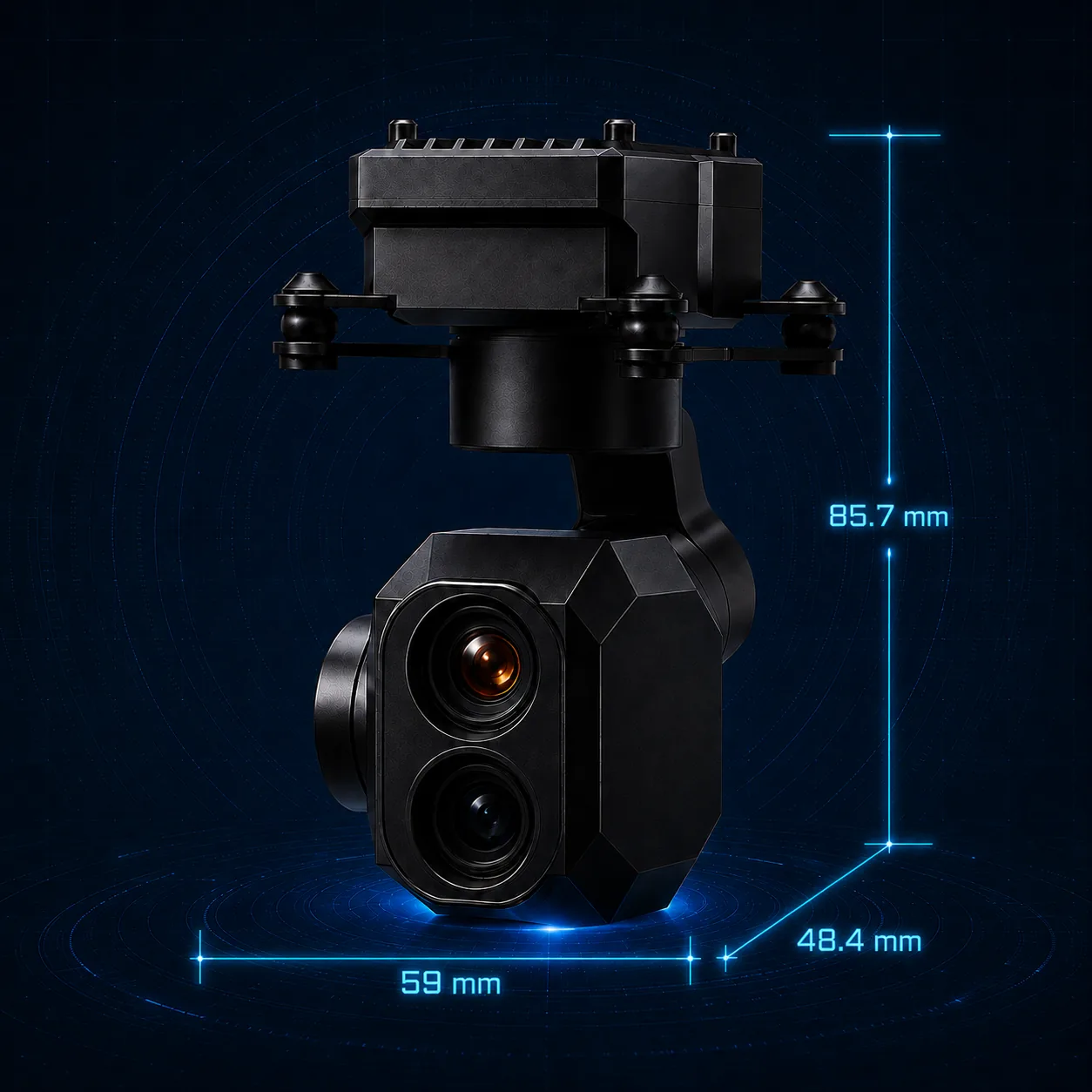
Cooled thermal cameras detect finer temperature differences at longer range; uncooled microbolometers fly on ten thousand drones for every cooled unit airborne. Weight, power, price and reliability made that decision — not image quality.
- 12 µmPixel pitch across the line
- <40 mKBest published NETD (MV-2P)
- 8–14 µmLWIR spectral band
- 0 sCooldown before first image
Key takeaways
- Cooled photon detectors win on sensitivity and long range; uncooled microbolometers win on mass, power, price and mean time between failures.
- Every UAVThermal payload flies an uncooled VOx microbolometer — the correct engineering answer below roughly 2 kg of payload mass.
- Published NETD across the line runs <40 mK on the MV-2P and <50 mK on the 640×512 pods; pixel pitch is 12 µm throughout.
- A cooled core needs minutes at cryogenic temperature before it can image at all. An uncooled core is live on power-up.
On this page
How Each Detector Actually Works
A cooled detector counts infrared photons directly. The sensing material is a semiconductor whose electrons respond to individual LWIR or MWIR photons, and to keep thermal noise from drowning that signal the focal plane is held at cryogenic temperature by an integrated Stirling cooler — a small, precise, mechanical refrigerator bolted to the detector.
An uncooled microbolometer does something cruder and far more robust. Each pixel is a tiny suspended membrane of vanadium oxide that warms slightly when infrared energy lands on it; the readout measures the resulting change in electrical resistance. No cooler, no cryogenics, no moving parts, no cooldown wait. How uncooled VOx microbolometers work covers the physics in detail.
Both approaches read the same scene. They differ in how much signal they extract from it, and in what that extraction costs.
The Four-Way Trade
Cooled wins sensitivity — the 10–20 mK class against 40–60 mK for uncooled — and it wins long-range performance, because finer sensitivity plus MWIR optics push detection further. Uncooled wins everything else, and it wins by margins that are not close.
| Dimension | Cooled photon detector | Uncooled microbolometer |
|---|---|---|
| Sensitivity (NETD) | 10–20 mK class | 40–60 mK class |
| Detector mass | Kilograms with cooler and dewar | Grams |
| Detector power | Tens of watts | Milliwatts |
| Unit price | Order of magnitude higher | Baseline |
| Mean time between failures | Limited by the Stirling cooler | No wear-out mechanism |
| Time to first image | Minutes of cooldown | Immediate |
Read that table as a systems engineer rather than an image-quality reviewer. Three of the six rows — mass, power and MTBF — are exactly the rows that decide whether something can fly on a multirotor at all. A payload needing kilograms of detector and tens of watts of cooling has already ruled out the airframe class most inspection and public-safety work uses.
What the UAVThermal Line Actually Flies
Every thermal payload in the range uses an uncooled VOx microbolometer. The published figures show where the current generation sits.
| Payload | Thermal resolution | Pixel pitch | Spectral band | Published NETD |
|---|---|---|---|---|
| MV-2M | 256×192 | 12 µm | 8–14 µm | <50 mK @ 25 °C |
| MV-2P | 640×512 | 12 µm | 8–14 µm | <40 mK @ 25 °C |
| OP-90A | 640×512 | 12 µm | 8–12 µm | <50 mK @ 25 °C |
| OP-90P | 640×512 | 12 µm | 8–14 µm | <50 mK @ f/1.0, 25 °C |
| OP-125A | 640×512 | 12 µm | 8–14 µm | <50 mK @ f/1.0, 25 °C |
| LX-9B | 640×512 | 12 µm | 8–14 µm | <50 mK @ f/1.0, 25 °C |
Read the condition, not just the number. An NETD figure means nothing without its measurement conditions. “<50 mK @ f/1.0, 25 °C” and “<50 mK @ 25 °C” are not necessarily the same claim, and a figure quoted at f/1.0 with a slower lens actually fitted will not be what you see. Thermal sensitivity explained unpacks this properly.
Where Cooled Still Wins — and Who Flies It
Cooled MWIR is not obsolete; it is simply in a different market. Programmes needing to detect a person at ranges where an uncooled core sees nothing — long-endurance maritime patrol, wide-area border surveillance from altitude, defence ISR — still fly cooled sensors, on aircraft with the mass budget, the power bus and the maintenance organisation to support a Stirling cooler.
In practice those programmes are flying a different aircraft class entirely. If your platform is a sub-25 kg multirotor or a small VTOL, the question is not “cooled or uncooled” — the mass budget answered it before you started specifying. What remains is choosing well within uncooled: resolution, pixel pitch, lens, and whether you need radiometric temperature measurement.
It is also worth being blunt about why LWIR rather than MWIR dominates the uncooled world. Microbolometers respond broadly across the 8–14 µm atmospheric window, where terrestrial objects at ambient temperature radiate most strongly and the atmosphere is relatively transparent. That match is what makes an uncooled core useful at all.
What Improves Next
Pixel pitch has already moved from 17 µm to 12 µm, with 8 µm emerging. Each generation shrinks the detector for a given resolution, which shrinks the optics, which shrinks the gimbal — the whole game on a small aircraft. It also narrows the band of missions where uncooled is not quite enough. Why 12 µm replaced 17 µm covers the trade in detail: smaller pixels collect less energy each, so the gain is not free.
The second axis of improvement is processing rather than physics. Noise reduction, non-uniformity correction and detail enhancement extract more usable contrast from the same raw frames than they did five years ago; the thermal image processing pipeline is where a large part of perceived sensitivity now comes from. Two cores with identical NETD can look meaningfully different on screen because of it.
Choosing Well Inside the Uncooled World
For a buyer, the decision that actually matters is not detector family but the trio of resolution, NETD and lens. A 640×512 core at <50 mK on a well-matched f/1.0 lens will outperform a nominally more sensitive core behind slow optics. Resolution decides how many pixels land on your target — see 256×192 vs 640×512 — and NETD decides how small a temperature difference survives the noise floor.
The common purchasing error is paying for sensitivity the mission cannot use. Finding a hot bearing or a wet roof is a large-signal problem; the delta-T is degrees, not millikelvin. Finding a person in cool grass at 400 m is a small-signal problem where NETD and pixel count both bite. Match the spend to whichever of those two you actually do most weeks.
And if a vendor answers “cooled or uncooled?” with anything other than “uncooled, here is why” on a payload this size, ask them to show their mass and power budget.
Related reading
- How Uncooled VOx Microbolometers Work
- Thermal Infrared Optics: Germanium Lenses and f/1.0 Apertures
- The Thermal Image Processing Pipeline: NUC, FFC, AGC
- Why Thermal Cameras Live at 8–14 µm: The LWIR Window
- Thermal Sensitivity (NETD) Explained for UAV Payload Buyers
- Thermal Pixel Pitch: Why 12 µm Replaced 17 µm
- 256×192 vs 640×512: Choosing Drone Thermal Camera Resolution
- MV-2M — 110 g dual-sensor micro pod
- MV-2P — 640×512 thermal at 130 g
- OP-125A — 30x zoom multi-sensor pod
- LX-9B — multi-sensor pod with ranging
- Solar Farm Thermal Inspection with UAV Payloads
FAQ
Will uncooled sensitivity keep improving?
Yes, and it already has. Pixel pitch has moved from 17 µm to 12 µm with 8 µm emerging, and each generation narrows the band of missions where uncooled is not quite sufficient. Progress in readout electronics and image processing adds usable contrast on top of the raw detector improvement. The gap to cooled MWIR will not close — the physics is different — but the set of jobs that need cooled keeps shrinking.
Why do cooled cameras need minutes to start?
The detector has to reach cryogenic temperature before it can image, and the Stirling cooler needs time to get it there. That wait is thermodynamics, not firmware, so no software update will remove it. For a drone launched in response to an incident, several minutes of cooldown is often the whole reason cooled was ruled out, quite apart from mass and power.
Does every UAVThermal payload use the same thermal core?
All of them are uncooled VOx microbolometers at 12 µm pixel pitch, but they are not identical. Resolution splits between 256×192 and 640×512, published NETD runs from under 40 mK on the MV-2P to under 50 mK on the 640×512 pods, and the spectral band is 8–14 µm on most units and 8–12 µm on the OP-90A. Check the specific model rather than assuming line-wide equivalence.
Questions about the technology? Talk to our engineers — we reply within 2 business days.