

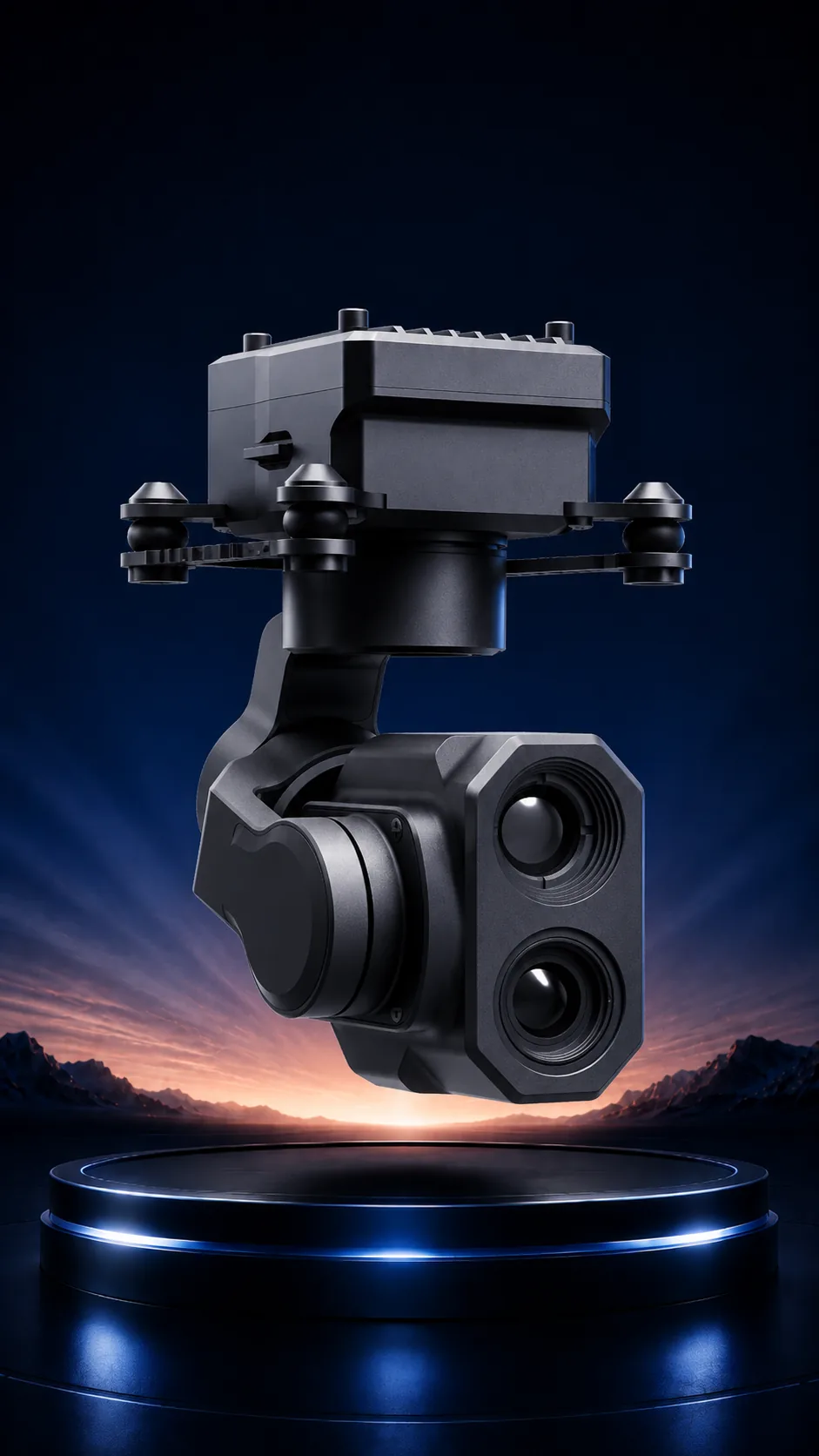
Shrinking thermal pixels from 17 µm to 12 µm let a 640×512 core use the physical sensor area of an older 384-class part — smaller germanium optics, lighter payloads, longer range per gram. It is the quiet enabler behind 130 g payloads carrying full 640 thermal.
- 12 µmCurrent generation pitch
- 17 µmWhat it replaced
- 8 µmThe next wave
- 130 g640×512 payload weight today
Key takeaways
- Sensor size equals resolution times pitch, so smaller pixels shrink the focal plane and therefore the lens for the same field of view.
- Germanium lens volume is a dominant cost and mass driver, which is why shrinking the focal plane matters more than it sounds.
- Smaller pixels collect less energy and historically cost sensitivity. Modern 12 µm cores recovered the gap through better vacuum packaging and readout design.
- Pitch appears next to resolution on every serious datasheet. Same resolution at smaller pitch usually means a newer core generation.
On this page
Pitch, Sensor Size and Optics
Sensor size is simply resolution multiplied by pitch. A 640×512 array at 17 µm measures about 10.9 × 8.7 mm; the same array at 12 µm measures about 7.7 × 6.1 mm. Same pixel count, substantially smaller piece of silicon.
That shrinkage propagates outward. A smaller focal plane needs a shorter focal length for the same field of view, and a shorter focal length means a smaller lens. Since germanium lens volume is a dominant cost and mass driver in every thermal payload — germanium lenses and f/1.0 apertures covers why — shrinking the sensor is the most effective way to shrink the whole optical assembly.
This is the mechanism behind the entire micro payload category. A 640×512 thermal channel in a 130 g pod like the MV-2P is not a triumph of packaging alone; it is what happens when the sensor and therefore the optics get small enough to fit. Sub-250 g payloads covers what that unlocked operationally.
The Sensitivity Trade
Smaller pixels collect less energy. A 12 µm pixel presents roughly half the area of a 17 µm one, and with less incident radiation per pixel the signal-to-noise ratio suffers — which historically cost NETD, the measure of the smallest temperature difference the core can resolve.
Modern 12 µm microbolometers recovered the gap through better vacuum packaging and readout design. Improved vacuum in the sensor package reduces thermal conduction away from each suspended membrane, so more of the absorbed energy produces a measurable resistance change, and better readout electronics extract more signal from what remains. Production 12 µm cores now match the sensitivity classes of older 17 µm sensors.
The published figures across the line reflect that maturity — 12 µm pitch throughout, with NETD from under 40 mK on the MV-2P to under 50 mK on the 640×512 pods. Thermal sensitivity explained covers how to read those figures with their conditions attached.
| Payload | Thermal resolution | Pixel pitch | Published NETD |
|---|---|---|---|
| MV-2M | 256×192 | 12 µm | <50 mK @ 25 °C |
| MV-2P | 640×512 | 12 µm | <40 mK @ 25 °C |
| OP-90A | 640×512 | 12 µm | <50 mK @ 25 °C |
| OP-90P | 640×512 | 12 µm | <50 mK @ f/1.0, 25 °C |
| OP-125A | 640×512 | 12 µm | <50 mK @ f/1.0, 25 °C |
| LX-9B | 640×512 | 12 µm | <50 mK @ f/1.0, 25 °C |
Pitch and Range
At equal focal length, smaller pitch narrows the instantaneous field of view of each pixel — more pixels land on a target at a given distance, which is exactly the quantity that governs detection and identification range. So on paper, smaller pitch buys range.
The caveat is that this holds until sensitivity limits catch up. More pixels on target only helps if each pixel still resolves the temperature difference you are looking for; a target that is well sampled but below the noise floor is not detected. In practice the two effects trade against each other, and the net gain depends on the scene contrast.
For high-contrast targets — a person against cool ground, a hot connector against ambient metal — the pixel-count gain dominates and smaller pitch genuinely extends range. For marginal contrast it does not. DRI ranges explained covers the pixels-on-target model, and thermal lens focal length covers the other half of the same equation.
What Buyers Should Check
Pitch appears on every serious datasheet next to resolution, and its absence is itself informative. If a specification lists resolution without pitch, ask — the number exists and there is no good reason to omit it.
The same resolution at a smaller pitch usually means a newer core generation, with the readout and packaging improvements that came with it. Two payloads both claiming 640×512 where one is 17 µm and one is 12 µm are not contemporaries, and the newer one will generally be lighter, smaller and no less sensitive.
- Read resolution and pitch together — one without the other tells you little.
- Compare NETD with its measurement conditions attached, not the bare number.
- Check the resulting optics: a smaller focal plane should show up as a lighter, more compact payload.
- Ask what generation the core is if pitch is absent from the datasheet.
And keep the priority order straight. Pitch is a useful generational indicator, but resolution, lens speed and stabilisation all affect delivered imagery more directly — see what buyers should ignore first.
The 8 µm Wave
First 8 µm products exist. Expect the mainstream shift as yields and NETD mature, exactly as 12 µm did — the same cycle, with the same early period where the new pitch is available but not yet clearly better.
The pattern is worth recognising because it repeats. Each generation shrinks the focal plane, shrinks the optics, and initially costs sensitivity that packaging and readout improvements then recover over a few years. Buying at the start of that curve gets you the size benefit and the unrecovered sensitivity penalty; buying in the middle gets you both.
For most buyers the practical guidance is unglamorous: 12 µm is the mature generation today and there is no need to wait. The 8 µm transition will matter when it enables a payload class that does not currently exist, as 12 µm did for the 130 g full-640 pod — see uncooled vs cooled cores for where the technology sits overall.
Related reading
- How Uncooled VOx Microbolometers Work
- Thermal Infrared Optics: Germanium Lenses and f/1.0 Apertures
- From NETD to DRI
- Thermal Sensitivity (NETD) Explained
- 256×192 vs 640×512 Resolution
- Thermal Lens Focal Length on Drones
- Uncooled vs Cooled Thermal Cores
- Sub-250 g Drones, Real Thermal
- MV-2P — 640×512 thermal at 130 g
- OP-125A — 30x optical multi-sensor pod
- LX-9B — multi-sensor pod with ranging
- Solar Farm Thermal Inspection
FAQ
Does smaller pitch mean more range?
At equal focal length, yes — smaller pitch narrows each pixel’s instantaneous field of view, so more pixels land on a distant target, and pixels on target is what governs detection range. The gain holds until sensitivity limits catch up: a well-sampled target still has to exceed the noise floor. For high-contrast scenes the pixel-count benefit dominates; for marginal contrast it does not.
Is 8 µm ready for UAV payloads?
First products exist, and the mainstream shift should follow as yields and NETD mature — exactly the path 12 µm took. Early in that curve you get the size benefit with a sensitivity penalty not yet recovered by packaging and readout improvements. For buyers today, 12 µm is the mature generation and there is no reason to wait for 8 µm unless it enables a payload class that does not currently exist.
Why does pitch affect payload weight so much?
Because sensor size equals resolution times pitch, and lens size scales with sensor size for a given field of view. Thermal lenses are germanium, which is dense and expensive, so lens volume drives both cost and mass more than almost any other component. Shrinking the focal plane from 17 µm to 12 µm shrinks the optics substantially, which is the actual reason a 640×512 thermal channel now fits in a 130 g pod.
Questions about the technology? Talk to our engineers — we reply within 2 business days.