

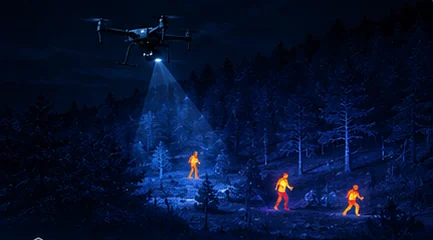
When a spec sheet says “detects a person at 1,000 m”, it means one thing only: at that range the target occupies enough pixels to notice something is there. Recognising it as a human happens at roughly half that distance, and identifying details at roughly a quarter.
- 2xPixels needed per DRI step
- 2 standardsEN 62676-4 and Johnson
- ~12xGap between the two
- 30–50%Real-world planning margin
Key takeaways
- Each DRI step needs roughly double the pixels on target of the previous one — that is the whole model.
- Two standards are in circulation and they differ by roughly an order of magnitude. EN 62676-4:2015 is conservative; Johnson Criteria numbers are far larger.
- Vendors quote detection because it is the biggest number. Honest comparison needs the same target size, the same criterion and the stated lens and core.
- Plan search missions on recognition range, not detection, and apply a 30–50% margin to laboratory figures for real weather.
On this page
The Three Thresholds
Detection: something warm is present. Recognition: it is a person, not a deer. Identification: posture, carried objects, individual features. Each step needs roughly double the pixels on target of the previous one — this is the Johnson criteria model, and it is the reason the three numbers on a datasheet fall in a neat 4:2:1 pattern.
That pattern is worth memorising because it lets you sanity-check any claim instantly. If a vendor quotes a detection range and an identification range that are not roughly four times apart, either they are using a different standard, a different target, or the numbers are not from the same measurement.
The underlying quantity is pixels on target, which depends on the target’s physical size, the range, the lens focal length and the detector’s pixel pitch. Nothing about it is specific to thermal — from NETD to DRI works through how the calculation is actually done.
Two Standards, One Order of Magnitude Apart
This is the single most important thing to know before comparing datasheets, and it is where most confusion originates. Two standards are in common use and they do not produce similar numbers.
EN 62676-4:2015 comes from the video surveillance world and is deliberately conservative — it asks what an operator can reliably do with the image. Johnson Criteria is the older military-derived model and produces figures roughly an order of magnitude larger for the same hardware. Neither is wrong. They answer different questions, and a datasheet quoting only one of them without saying which is not comparable to anything.
| Payload | EN 62676-4 detection (person) | EN 62676-4 identification (person) | Johnson detection (person) | Johnson identification (person) |
|---|---|---|---|---|
| MV-2M | 175 m | 35 m | 2,069 m | 517 m |
| MV-2P | 175 m | 35 m | 2,069 m | 517 m |
| OP-80A | 709 m | 142 m | 8,103 m | 2,026 m |
| OP-90A | 709 m | 142 m | 8,103 m | 2,026 m |
| OP-80N | 927 m | 185 m | 10,586 m | 2,647 m |
| OP-80P | 1,449 m | 290 m | 16,552 m | 4,138 m |
| OP-90P | 1,651 m | 330 m | 18,862 m | 4,716 m |
| OP-80U | 1,854 m | 371 m | 21,172 m | 5,293 m |
| LX-6N | 2,213 m | 443 m | 25,276 m | 6,319 m |
| OP-125A | 3,283 m | 657 m | 37,500 m | 9,375 m |
| LX-9B | 3,283 m | 657 m | 37,500 m | 9,375 m |
| LX-6U | 5,229 m | 1,046 m | 59,724 m | 14,931 m |
Always state which standard you are quoting. An RFP that asks for “1,500 m person detection” without naming a standard will receive bids that differ by a factor of ten and are all technically responsive. Writing requirements vendors cannot game covers how to close this.
A Label Mismatch Worth Knowing
The acronym says Detection, Recognition, Identification, but manufacturer datasheets — including the ones behind the table above — frequently label their three tiers Detection, Identification, Verification. The middle and final rungs carry different names than the DRI acronym leads you to expect.
This is not a trick; it reflects the vocabulary of EN 62676-4, which defines its own ladder of operator tasks. But it does mean that “identification” on one datasheet may sit at the rung you would call “recognition” on another. When comparing two vendors, compare the definitions rather than the labels, and if the definitions are not printed, ask for them.
The practical habit: read the number, then read what task it claims to support, and ignore the word attached to it until you have checked both.
Why Vendors Quote Detection
Because it is the biggest number. That is the entire explanation, and it is not dishonest as long as the conditions are stated — the problem is a buyer reading a detection figure and imagining an identification capability.
Honest comparison requires three things held constant: the same target size — a NATO standard person or vehicle, not an unspecified “target” — the same criterion, and the stated lens and core configuration. Change any one and the number moves substantially. A 30x zoom optic and a wide lens on the same detector produce completely different DRI figures, which is why quoting DRI without the optical configuration is meaningless.
The related distortion is quoting vehicle figures where the reader assumes person figures. A large vehicle detects at roughly six to seven times the range of a person on the same hardware, so a headline number can be technically accurate and practically irrelevant to a search mission. How to read a thermal payload spec sheet covers where else the padding hides.
Applying DRI to Missions
Search planning should use recognition range, not detection, for altitude and lane spacing. Detecting a warm blob you cannot classify does not end a search — it starts a diversion. Planning lanes on the detection figure produces a grid that technically covers the area and practically generates contacts nobody can resolve. Search patterns for thermal drone SAR works through the geometry.
Security response should assume identification only at close standoff. This is precisely why dual-sensor payloads exist: thermal detects the presence at range, and the zoom channel identifies it once the aircraft has closed or the operator has zoomed in. Expecting a thermal channel alone to identify at its detection range is the most common specification error in perimeter programmes — one multi-sensor payload or several cameras covers the trade.
For a worked example against real hardware rather than a general model, how far a drone thermal camera detects a person runs the numbers across six payloads.
The Real-World Margin
Every figure above is a laboratory calculation from optics and detector geometry. It assumes a clear atmosphere, a target with useful thermal contrast against its background, and an operator who is looking at the right part of the frame.
Reality subtracts from all three. Humidity, rain and fog attenuate LWIR, so applying a 30–50% margin to laboratory numbers is the standard planning discipline — what actually still works in fog, rain and humidity quantifies the conditions. Thermal contrast is the second subtraction: a person in cool grass at dawn is a strong target, and the same person on sun-warmed asphalt in the afternoon may be nearly invisible regardless of how many pixels land on them.
The third is attention. A target that occupies the theoretical minimum pixel count is a few pixels moving slowly across a busy frame, and human operators miss those routinely. This is where AI target tracking earns its place — not by seeing further than the physics allows, but by not getting bored.
Related reading
- From NETD to DRI: How Thermal Detector Performance Is Actually Calculated
- Thermal Infrared Optics: Germanium Lenses and f/1.0 Apertures
- How Far Can a Drone Thermal Camera Detect a Person?
- Thermal Lens Focal Length: Wide vs Narrow, Range vs Coverage
- How to Read a Thermal Payload Spec Sheet
- Writing Thermal Drone Requirements That Vendors Cannot Game
- Search Patterns for Thermal Drone SAR: Grid, Orbit and Contour
- One Multi-Sensor Payload or Several Cameras?
- OP-125A — 30x zoom multi-sensor pod
- LX-6U — 30x zoom, longest published DRI in the line
- MV-2P — 640×512 thermal at 130 g
- Border and Perimeter Surveillance Drones
- Thermal Drone Payloads for Search and Rescue
- FLIR Vue TZ20-R: dual-thermal payloads and the alternatives
- Multi-sensor payloads: do you use every module?
FAQ
Do weather conditions change DRI?
Yes. Humidity, rain and fog all attenuate long-wave infrared, and real-world planning applies a margin of 30–50% to laboratory numbers as a matter of routine. Thermal contrast matters just as much as attenuation: the same person is a strong target against cool grass at dawn and a weak one against sun-warmed asphalt in the afternoon, regardless of how many pixels land on them.
Is DRI relevant to visible zoom cameras?
Yes — the pixel-on-target logic applies identically, and only the contrast mechanism differs. A visible camera needs reflected light and adequate scene contrast where a thermal camera needs a temperature difference. That is why a dual-sensor payload is not redundant: the two channels fail under different conditions, and the DRI arithmetic that governs both is the same.
Which standard should I use when writing a specification?
Name one explicitly, and EN 62676-4:2015 is usually the safer choice because it is conservative and closer to operational reality. The critical point is not which you pick but that you pick: a requirement for “1,500 m person detection” with no standard named will attract bids that differ by roughly a factor of ten and are all technically responsive. Also specify the target — person, light vehicle or large vehicle — and require the lens and core configuration the figure was calculated for.
Questions about the technology? Talk to our engineers — we reply within 2 business days.