

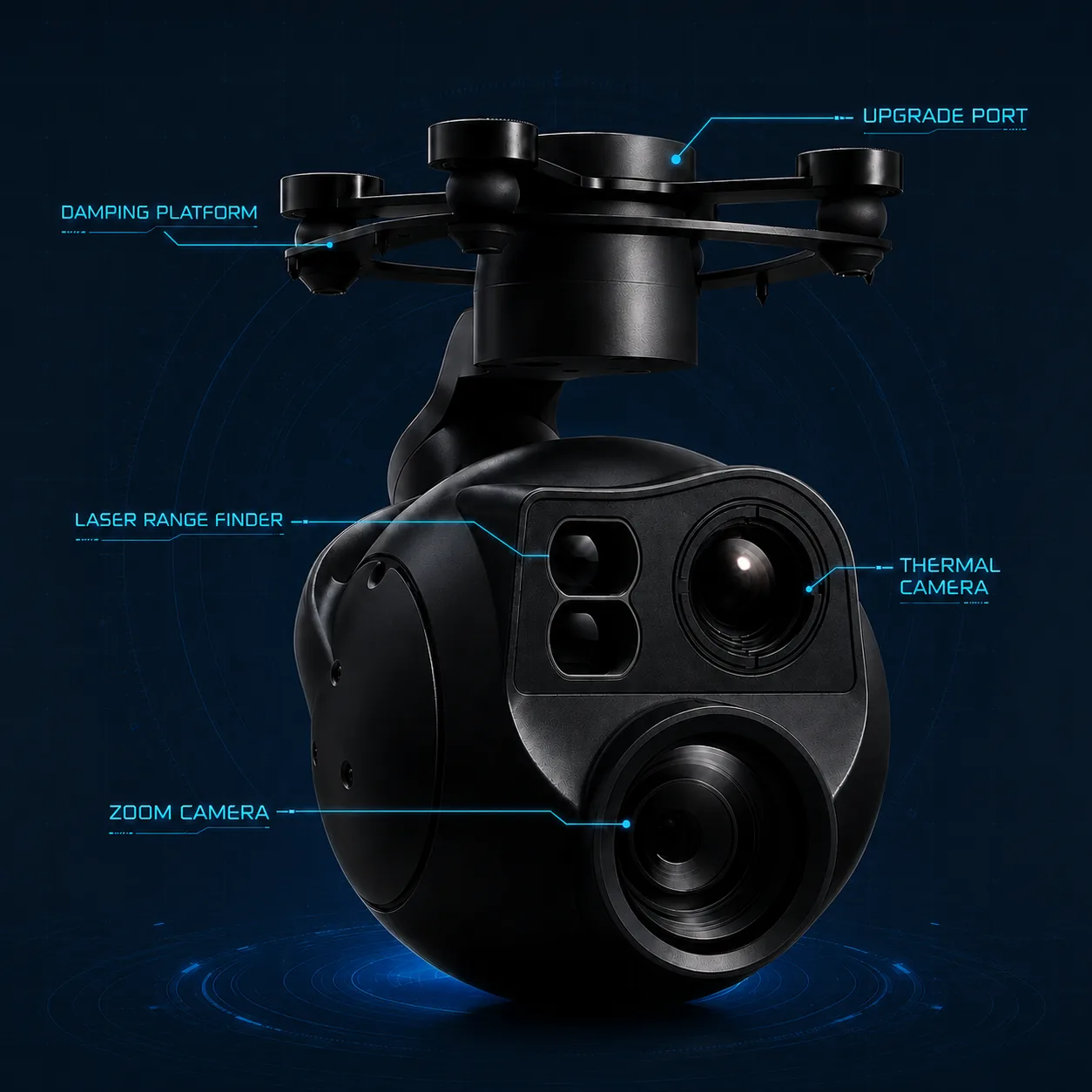
Hybrid zoom = optical zoom × digital zoom. A “120x hybrid” payload like the OP-125A delivers real optical magnification first, then digital enlargement on top — and only the optical part adds true detail.
- 30xOptical share of OP-125A’s 120x
- 1500xHighest hybrid figure in the line
- ~30xWhere stability becomes the limit
- 20.35 MPSensor behind the 1500x figure
Key takeaways
- Optical zoom changes focal length and captures more real detail. Digital zoom crops and enlarges pixels that already exist.
- Multiplying the two is legitimate shorthand — as long as you know the optical share, which is the only part that adds information.
- Sensor resolution decides how much digital enlargement survives before smearing: a 20.35 MP sensor sustains far more than a 2 MP one.
- Past roughly 30x magnification, gimbal jitter rather than optics usually caps usable zoom.
On this page
Optical, Digital, Hybrid
Optical zoom changes focal length. Moving lens elements narrow the field of view and project a larger image of the subject onto the same sensor, so more sensor pixels land on the target. This adds real detail that was not previously recorded.
Digital zoom crops and enlarges pixels that already exist. No new information enters the image; the processor selects a portion of the frame and scales it up, with interpolation filling the gaps. It is useful — it saves the operator zooming in during review, and it makes framing easier on a small screen — but it cannot recover detail the optics did not resolve.
Hybrid multiplies the two. A 30x optical block with 4x digital on top is marketed as 120x, and that arithmetic is legitimate shorthand rather than a lie. The problem is only that a reader who does not know the split cannot compare two payloads, because a 120x figure could be 30x optical × 4x digital or 10x optical × 12x digital, and those are very different cameras.
This is also why reading a spec sheet properly starts with finding the optical figure. It is always published; it is just rarely the headline.
The Real Numbers Across the Line
Setting the optical and digital shares side by side shows how differently the same hybrid figure can be assembled.
| Payload | Optical | Digital | Hybrid | Sensor |
|---|---|---|---|---|
| OP-90A | 10x | 3x | 30x | 1/2.8″ CMOS, 2.07 MP |
| OP-80P | 10x | 4x | 40x | 1/2.8″ CMOS, 8.29 MP |
| OP-90P | 10x | 6x | 60x | 1/2.8″ CMOS, 8.29 MP |
| OP-80U | 10x | 8x | 80x | 1/2.8″ CMOS, 8.29 MP |
| LX-6N | 20x | 6x | 120x | 1/1.8″ CMOS, 4.09 MP |
| OP-125A | 30x | 4x | 120x | 1/2.8″ CMOS, 4.09 MP |
| LX-9B | 30x | 4x | 120x | 1/2.8″ CMOS, 4.09 MP |
| LX-6U | 30x | 8x | 240x | 1/2.8″ CMOS, 8.29 MP |
| LX-8RB | 30x | 12x | 360x | 1/2.8″ CMOS, 2.07 MP |
| LX-8RC | 20x | 75x | 1500x | 1/2.3″ CMOS, 20.35 MP |
Compare the LX-6N and the OP-125A. Both are marketed at 120x, and they get there completely differently — 20x optical × 6x digital against 30x optical × 4x digital. The OP-125A resolves more real detail at the long end because half again as much of its magnification is optical. A buyer comparing only the hybrid number would see them as equivalent.
How to Judge Real Reach
Ask for the optical zoom factor and the sensor resolution. Those two numbers together tell you what the payload can actually resolve, and everything else is presentation.
Sensor resolution matters because it sets how much digital enlargement the image tolerates before visible smearing. A 20.35 MP sensor behind strong optics — as on the LX-8RC, which reaches 1500x hybrid — sustains far more digital enlargement than a 2 MP sensor would, because there are simply more real pixels to crop into. That is the entire reason its digital multiplier can be 75x when other pods stop at 3x or 4x.
A correction worth noting. The 20.35 MP sensor and 1500x hybrid figure belong to the LX-8RC. Earlier versions of this guide attributed them to the LX-6C; the published specification PDFs place them on the LX-8RC, and the figures above follow the PDFs.
The second question is what the optics resolve, which the specification does not tell you directly. A long optical zoom behind a mediocre lens produces a large, soft image. This is where asking for sample imagery at full optical zoom, on a real target at real distance, beats any datasheet comparison — and continuous zoom optical design explains what a long zoom block costs in size, weight and light.
Stability Is the Hidden Limit
Past roughly 30x magnification, gimbal jitter — not optics — usually caps usable zoom. Magnification multiplies apparent motion, so a disturbance that is invisible at wide angle sweeps a large share of the frame at narrow telephoto. The lens is fine; the mount has become the bottleneck.
This is why ±0.01° class stabilisation matters more as the zoom number grows. At 1,000 m, 0.01° of error moves the aim point 17 cm while 0.1° moves it 1.7 m — what ±0.01° means at 1,000 metres works through the arithmetic, and gimbal stabilization technology covers how that figure is achieved.
The practical consequence for buyers: a high hybrid figure on a payload with mediocre stabilisation is a specification you cannot spend. Read the two numbers together, and if only one is prominently published, assume the other is the weak one.
And Then There Is the Atmosphere
Even with perfect optics and a perfectly steady mount, there is a ceiling. Thermal shimmer — air of differing temperature and density between the camera and the subject — degrades long-range imagery in a way no amount of magnification or stabilisation corrects. On a warm afternoon over a hot surface it can be the dominant limit well before the optics run out.
Past the point where atmospheric shimmer and platform vibration dominate, extra digital multiplication adds size without information. The image gets bigger and no clearer, which is a reliable way to tell you have exceeded the system’s real reach. Operators learn to recognise it quickly; buyers reading datasheets often do not.
Time of day and viewing geometry are the levers that actually help. Early morning observation over cool ground beats midday over asphalt at the same range, and a steeper look angle passes through less horizontal air than a shallow one.
Choosing for the Mission
30x optical class covers most tower hardware from safe standoff, which is the workload of the majority of utility inspection programmes. Insulators, dampers, splices and fittings are legible at that reach without the aircraft entering the exclusion zone — see power line inspection payloads.
EHV work and river crossings justify 120x-class hybrid systems, because the standoff is genuinely larger and the alternative is an aircraft closer to energised conductors than anyone wants. That is a real requirement rather than a specification preference.
Below that, be honest about what you need. A payload chosen for a headline zoom figure it will use twice a year is mass and money that could have gone into thermal resolution or endurance. What buyers should ignore first covers this category of over-specification, and choosing a payload without spec noise covers the general discipline.
Related reading
- Continuous Zoom Optical Blocks: What 10x to 40x Costs in Size, Weight and Light
- Gimbal Stabilization Technology: How ±0.01° Steadiness Is Achieved
- What ±0.01° Gimbal Accuracy Means at 1,000 Metres
- How to Read a Thermal Payload Spec Sheet
- What UAV Thermal Payload Buyers Should Ignore First
- How to Choose a UAV Thermal Payload Without Spec Noise
- DRI Ranges Explained
- OP-125A — 30x optical, 120x hybrid
- LX-8RC — 20.35 MP sensor, 1500x hybrid
- LX-6U — 30x optical, 240x hybrid
- LX-6C — 20x optical zoom payload
- Power Line Inspection Drone Payloads
FAQ
Is more hybrid zoom always better?
No. Past the point where atmospheric shimmer and platform vibration dominate, extra digital multiplication adds size without information — the image gets bigger and no clearer. Since digital zoom contributes nothing the optics did not already resolve, a very large hybrid figure on a modest optical block is mostly a marketing number. Compare optical factors and sensor resolution instead.
What zoom do utility inspections need?
30x optical class covers most tower hardware from safe standoff, which handles the majority of routine inspection work — insulators, dampers, splices and fittings are all legible at that reach without approaching energised conductors. EHV lines and river crossings justify 120x-class hybrid systems because the standoff is genuinely greater. Below EHV, a larger figure is usually mass and budget that would serve you better as thermal resolution or endurance.
Why do two payloads with the same hybrid number perform differently?
Because the split differs. The LX-6N reaches 120x as 20x optical times 6x digital, while the OP-125A reaches the same 120x as 30x optical times 4x digital. The OP-125A resolves more real detail at the long end because more of its magnification is optical. Sensor resolution compounds the difference, since a higher-resolution sensor tolerates more digital enlargement before the image visibly smears.
Questions about the technology? Talk to our engineers — we reply within 2 business days.