

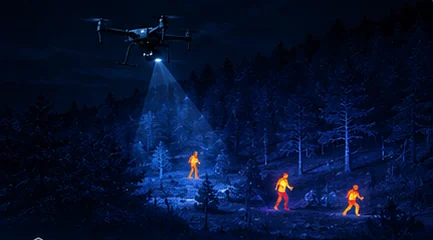
SAR drone kits fail in the field for boring reasons: dead batteries, missing cables, no way to hand coordinates to ground teams. This checklist is the boring insurance.
- 3xBatteries vs expected search window
- 2People per drone team
- 640×512Thermal resolution baseline
- 1 cardLaminated detection ranges
Key takeaways
- Kit failures dominate mission failures. The gear that breaks a callout is almost never the camera.
- Carry batteries for three times the expected search window, plus field charging and winter warmers.
- A coordinate handoff procedure is equipment, not etiquette — decide before the callout how a position reaches ground teams.
- The single biggest improvement in find rates is not hardware: it is altitude discipline and lane spacing derived from your own payload’s recognition range.
On this page
What This List Covers
This is the kit list. It deliberately does not cover search patterns — grid, orbit and contour selection is a technique question handled in search patterns for thermal drone SAR — and it does not cover overwater work, where salt, spray and drift modelling change the requirements enough to warrant their own guide.
What it covers is what goes in the vehicle, and why each item is there. Teams that have run a few callouts recognise most of this. Teams that have not tend to discover it one item at a time, usually at two in the morning in bad weather.
Sensing Core
A 640×512 thermal payload is the baseline, and the reason is detection range headroom rather than image quality for its own sake. Resolution sets how many pixels land on a person at a given altitude, which sets how high you can fly, which sets how much ground you cover per battery. On a time-critical search that chain is the whole argument — the SAR payload guide covers it in depth.
A visible zoom or starlight channel for confirmation is the second requirement, and it is not optional in practice. Thermal finds a warm object; something has to establish whether it is your missing person, a deer, or a compost heap. Sending ground teams to every thermal contact exhausts them before they reach the real one.
NIR illumination belongs in the kit if zero-light identification is mission-normal for your terrain. Multi-sensor units like the MV-4X consolidate the whole stack into one pod, which matters when the alternative is swapping payloads in the dark.
| Capability | Why it is on the list | Consequence if missing |
|---|---|---|
| 640×512 thermal | Detection range headroom sets usable altitude | Fly lower, cover less, take longer |
| Visible zoom or starlight | Confirms the contact is a person | Ground teams chase every warm object |
| NIR illumination | Identification in zero ambient light | Contacts stay unresolved until dawn |
| Laser rangefinder | Converts an observation into a coordinate | Position handoff becomes verbal landmark description |
| AI tracking | Holds the subject while the aircraft repositions | Operator flies the camera instead of watching |
Power and Endurance
Carry batteries for three times the expected search window. Not twice — searches extend, aircraft return early on wind, and a battery that has been sitting in a cold vehicle delivers less than its rating. Three times is the figure that survives contact with an actual callout.
Field charging is the second layer: a vehicle inverter or a generator, tested with your actual charger before you need it. A team that can recharge on scene is not limited by what it brought; a team that cannot has a hard stop it may not have calculated.
Battery warmers matter for winter callouts, and the effect is larger than most teams expect — cold cells sag under load and shut down early. Cold-weather thermal drone operations covers the handling, and the same conditions that reduce endurance often improve thermal contrast, so winter searches are simultaneously more productive and more logistically demanding.
Do the arithmetic on payload draw too. A pod that fires a rangefinder and runs an illuminator draws considerably more than its average figure suggests — see payload power budgets and payload weight versus flight time.
Data and Coordination
A coordinate handoff procedure is the item most often absent and most consequential. Decide before the callout how a position gets from the drone operator to a ground team: what format, over what channel, confirmed how. LRF-equipped payloads geo-tag targets directly — see why an LRF matters — but the number still has to travel to someone who can act on it.
Screen-record capability for debrief serves two purposes. It lets the team review what was actually visible when a contact was missed, which is how detection skill improves, and it produces a record for the incident file. Both matter more than they seem during the callout.
Radio integration or a runner protocol between drone operator and search command. If the operator is on a different net from the searchers, someone has to bridge it, and that person needs to exist by name before the mission rather than being improvised.
The Forgotten Items
Every experienced team has a version of this list, written after the callout where the item was missing.
- Spare props and the tools to change them — the failure that ends a search fastest is mechanical and trivial.
- Lens cloths. Thermal optics fog, and a germanium lens with condensation on it is a blind camera.
- Printed emergency procedures, because the phone with the checklist on it is the phone with 4% battery.
- A sunshade for the controller. Daylight searches fail on unreadable screens more often than anyone admits.
- A laminated card of your own detection-range numbers per altitude, so lane spacing is arithmetic rather than guesswork.
The laminated card is the highest-value item on this list. Detection range varies with your payload, your altitude and the conditions. A card carrying your own measured numbers turns lane spacing from a judgement call into a calculation — and it is the one item that directly improves find rates.
Build the card from your own testing rather than from datasheet figures. Published DRI numbers are laboratory calculations under two different standards; what you need is what your team can actually see, on your terrain, at each altitude you fly.
Team Composition and the Thing That Actually Helps
Two people per drone: one flies the pattern, one watches the screen. Split attention finds fewer people. This is the most consistently ignored recommendation in SAR drone work, usually because a team has one qualified pilot and treats screen-watching as something the pilot can also do.
They cannot, and the reason is not skill. Flying a systematic pattern is an active task with its own attention load, and a person doing it is not giving full attention to a thermal feed where the target may be a few pixels moving slowly. AI detection helps — see how AI tracking actually works — but it supplements the observer rather than replacing them.
And the upgrade that most improves find rates is not hardware at all. It is altitude discipline and lane spacing derived from your payload’s recognition range, trained before you need it. A team flying a disciplined grid at a validated altitude with a modest payload outperforms a team improvising with an excellent one. Buy the training time before the next sensor.
Related reading
- From NETD to DRI: How Thermal Detector Performance Is Calculated
- Starlight and Low-Light Imaging
- Search Patterns for Thermal Drone SAR: Grid, Orbit and Contour
- Maritime SAR and Overwater Operations with Thermal Drones
- Cold-Weather Thermal Drone Operations
- Why a Laser Rangefinder Belongs on Your UAV Payload
- DRI Ranges Explained
- The Thermal Payload Pre-Flight Checklist
- MV-4X — micro quad-sensor pod
- OP-90A — zoom, thermal and ranging
- LX-9B — long-range multi-sensor pod
- Thermal Drone Payloads for Search and Rescue
FAQ
What single upgrade most improves find rates?
Not hardware — altitude discipline and lane spacing derived from your payload’s recognition range. Train it before you need it. A team flying a disciplined grid at a validated altitude with a modest payload consistently outperforms a team improvising with an excellent one, because coverage geometry determines whether the subject was ever in frame at all. No sensor recovers from a lane spacing that left gaps.
Team of one or two?
Two: one flies the pattern, one watches the screen. Split attention finds fewer people. Flying a systematic search pattern is an active task with a real attention cost, and the pilot doing it is not giving full attention to a feed where the target may be a few slow-moving pixels. AI detection reduces the observer’s load but does not remove the need for one.
Why three times the expected battery requirement?
Because searches extend, aircraft return early on wind, and cold batteries deliver less than their rating. Twice the expected window sounds generous until a two-hour search becomes five hours and the last flyable battery is the one you needed for the area nobody has covered yet. Pair the reserve with field charging — a vehicle inverter or generator tested with your actual charger — so the kit has no hard stop.
Questions about the technology? Talk to our engineers — we reply within 2 business days.