

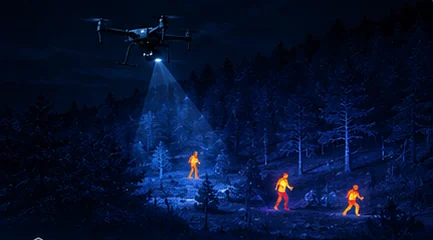
Search after dark changes the meaning of vision. The scene becomes less about colour, texture and distance, and more about contrast: a warm human signature against cooling terrain.
- <50 mKNETD that preserves the edge
- ConsistentAltitude and speed
- 2 channelsDetect then confirm
- CoordinateWhat the ground team needs
Key takeaways
- Rocks that absorbed heat all day, livestock, warm engines and reflective surfaces all produce returns that look like a person at first glance.
- Altitude discipline matters as much as the sensor — consistent height and speed keep apparent target size predictable.
- A dual-sensor payload earns its weight at the confirmation step, turning a candidate hotspot into a confirmed target in seconds.
- A rescue coordinator acts on location, terrain and a credible reason — not on temperature alone.
On this page
The First Task Is to Separate Signal From Noise
Rocks that absorbed heat all day, livestock, warm vehicle engines and reflective surfaces all produce returns that can look like a person at first glance. An inexperienced crew wastes its battery chasing every bright pixel, and worse, wastes the ground team’s legs.
A useful search image is stable, readable and easy to compare with the visible scene. High thermal sensitivity — below 50 mK NETD — helps preserve the subtle edge between a body and ground that has been cooling for hours, which is exactly the marginal contrast that decides whether a signature is noticed at all. Thermal sensitivity explained covers why that figure and its f-number matter here more than resolution.
Altitude discipline matters as much as the sensor. Flying a consistent height and speed keeps apparent target size predictable, which is what lets the operator judge whether a signature is human-sized at all. A crew varying altitude has removed their own best discriminator — everything is an unknown size.
Thermal imaging is powerful because it removes distractions. It is risky when the operator forgets that context still matters.
Context Makes the Heat Source Useful
A rescue coordinator does not act on temperature alone. They need location, terrain, movement and a credible reason to send people into a specific area at night — because committing a ground team has a cost and a risk of its own.
This is where a dual-sensor payload earns its weight. Switching from thermal to a zoomed visible or low-light channel over the same stabilised line of sight turns a candidate hotspot into a confirmed target, or rules it out in seconds. Doing that over the same line of sight is the part that requires boresight alignment rather than two cameras — one multi-sensor payload or several cameras covers why field-swapped cameras cannot do it.
Payloads with a laser rangefinder add precise distance, which converts a bearing into a map coordinate the ground team can navigate to. That conversion is the difference between “there is something warm north of the treeline” and a grid reference — why an LRF belongs on your payload covers the chain and its error sources.
| Stage | Channel | What it answers |
|---|---|---|
| Detect | Thermal | Is there something warm here? |
| Confirm | Visible zoom or low-light | Is it a person, or a deer, or a rock? |
| Locate | Rangefinder plus gimbal angles | Where exactly, as a coordinate? |
| Hold | AI tracking | Keep it while the aircraft repositions |
What the Conditions Do to the Odds
Night generally improves thermal contrast for people, because the background has been cooling for hours and the subject has not. That is the whole reason night search works as well as it does.
But the advantage erodes. Wind strips surface temperature differences. Rain cools everything toward uniformity and attenuates the signal — fog, rain and humidity limits covers the derates, which run to half the published range in steady rain. And a subject who has been out for hours in cold conditions is a weaker target than one who has just become lost.
Cold is the double-edged case: excellent contrast, poor battery performance. Cold-weather thermal operations covers the 20–40% capacity loss to plan around, and it is the season when the contrast dividend and the endurance penalty arrive together.
Plan on recognition range, not detection range. A contact you cannot classify is not a find — it is a task for someone on the ground. Setting lane spacing from the range at which you can tell a person from an animal is what makes the coverage claim honest.
The Discipline That Separates Crews
Three habits, and none of them involves better equipment.
- Fly consistent altitude and speed so apparent target size stays a usable discriminator.
- Mark every candidate with a coordinate before descending to investigate any of them.
- Confirm on the second channel before committing a ground team.
- Log flown lanes so a second aircraft or shift resumes coverage instead of repeating it.
- Set lane spacing from your own measured recognition range, not from a datasheet figure.
The marking rule is the one most often broken and the most costly. An operator who descends on the first contact and loses it has no record of where it was, and the search restarts from nothing — with the battery partly spent.
For the full pattern discipline see search patterns for thermal drone SAR, and for the kit that makes the coordinate handoff possible see the SAR drone team equipment checklist. Overwater search changes the problem enough to warrant its own guide.
Why It Takes Two People
One flies the pattern, one watches the screen. Flying a disciplined search is an active navigation task, and the pilot doing it is not giving full attention to a feed where the target may be a few slow-moving pixels against a busy background.
This is the recommendation crews most often ignore, usually because there is one qualified pilot available. The result is a search flown competently and observed poorly, which finds fewer people — and the failure is invisible, because nobody knows what was in the frame and missed.
AI detection reduces the observer’s load meaningfully — a network flagging human-shaped returns does not get tired at hour three — but it supplements the observer rather than replacing them. It also has its own limits, and treating it as an autonomous system is how contacts get missed with more confidence than before.
The equipment that supports this is covered on the SAR application page; the crewing is free and matters more.
Related reading
- Starlight and Low-Light Imaging
- EO/IR Sensor Fusion and Boresight Alignment
- Search Patterns for Thermal Drone SAR
- The SAR Drone Team Equipment Checklist
- Maritime SAR and Overwater Operations
- Thermal Sensitivity (NETD) Explained
- Why a Laser Rangefinder Belongs on Your UAV Payload
- Thermal Drones in Fog, Rain and Humidity
- MV-4X — quad-sensor micro pod
- OP-90A — zoom, thermal and ranging
- LX-9B — long-range multi-sensor pod
- Thermal Drone Payloads for Search and Rescue
FAQ
Why is the first heat source rarely the answer?
Because sun-warmed rock, livestock, vehicle engines and reflective surfaces all produce returns that resemble a person at a glance. Night search generates contacts, and most of them are not the subject. The crews that find people are the ones that mark every candidate with a coordinate and confirm on a second channel before committing anyone, rather than descending on the first bright pixel and spending the battery.
Does thermal make night search easy?
It makes it possible where it previously was not, which is different. Thermal removes the distraction of darkness and replaces it with a new interpretation problem: everything warm looks similar at range. Sensitivity below 50 mK preserves the subtle edge between a body and cooling ground, altitude discipline keeps apparent size meaningful, and a second channel resolves what the thermal image cannot. Take any of those away and the advantage shrinks quickly.
What single change most improves night find rates?
A second crew member watching the screen. Flying a disciplined pattern is an active task, and a pilot doing both is observing poorly without knowing it — the missed contact leaves no trace. After that, altitude discipline and lane spacing set from your own measured recognition range. Both are free, and both outperform a sensor upgrade.
Questions about the technology? Talk to our engineers — we reply within 2 business days.