
Starlight sensors amplify existing light into full-colour imagery; NIR laser illumination adds invisible light where none exists; thermal imaging ignores light entirely and reads heat. No single technology wins at night — which is why serious night payloads stack them.
- 0.001 luxPublished minimum illumination
- 850±10 nmNIR illuminator wavelength
- 8–14 µmThermal band
- 3 stackedWhat flagship pods carry
Key takeaways
- Starlight amplifies what light exists and delivers colour detail — faces, plates, clothing — but fails in absolute darkness.
- An 850 nm illuminator is invisible to the eye and floods the scene for the sensor, extending identification range in true darkness.
- Thermal cannot be hidden from: heat cannot be switched off, and it works through light smoke and camouflage. It renders no identifying detail.
- The professional workflow is detect on thermal, identify on starlight or NIR, and let AI tracking hold the target across the handoff.
On this page
Starlight: Identification in Near-Darkness
Ultra-low-lux sensors deliver colour detail under moon and city glow — faces, plates, clothing, the things that identify rather than merely locate. This is the channel that answers “who is that”, and no thermal core will ever do it.
The published minimum illumination figures show how far the technology has come. The OP-80P publishes 0.001 lux at f/1.5 with night vision on; the OP-80A, OP-90D and OP-90A publish 0.0015 lux at f/1.6. Those are levels well below what a human eye resolves usefully.
But the limit is absolute rather than gradual: amplification needs something to amplify. In a genuinely lightless environment — inside a structure, under heavy canopy, on a moonless night far from any settlement — a starlight sensor sees nothing at all. Starlight and low-light imaging covers the sensor design and where the floor sits.
NIR Laser: Bringing Your Own Light
An 850 nm illuminator is invisible to the human eye but floods the scene for a sensor that responds to near-infrared. It extends identification range in true darkness and removes the dependence on ambient light entirely — you are no longer amplifying, you are lighting.
The published figures place these across the OP series: 850±10 nm emitters classified Class 3B under IEC 60825-1:2014 on the OP-80N, OP-80P and OP-80A. Note that this is the illuminator and not the rangefinder — the LRF on these pods is a separate 905 nm Class 1M device, as the LRF guide sets out. Confusing the two produces a risk assessment that is wrong in both directions.
The trade-offs are range and discretion. Illumination falls off with distance, so a NIR floodlight has a working envelope rather than unlimited reach. And it is invisible to the eye but perfectly visible to anyone else with a NIR-capable sensor, which matters in some security contexts. NIR laser illumination covers the beam design.
Thermal: Detection That Cannot Be Hidden From
Heat cannot be switched off. A 640×512 core detects a person at long range regardless of light, camouflage or light smoke, because the target is supplying the signal rather than reflecting one. Nothing an evading subject can do makes them stop radiating.
That makes thermal the detection channel by default. It works in absolute darkness, it works through light smoke — a point that matters for firefighting — and camouflage designed to defeat visible-light observation typically does nothing about an 8–14 µm signature. Why thermal cameras live at 8–14 µm covers the physics.
What it does not do is identify. A thermal image renders a warm shape, and the pixel count needed for identification is roughly four times that needed for detection — see DRI ranges explained. Solid cover also defeats it completely: LWIR does not penetrate walls, vehicles or dense canopy.
The Three Compared
Side by side, the complementarity is obvious — each one’s weakness is another’s strength.
| Starlight | NIR illumination | Thermal | |
|---|---|---|---|
| Needs ambient light | Yes — some | No, supplies its own | No |
| Works in absolute darkness | No | Yes, within beam range | Yes |
| Colour and identifying detail | Yes | Monochrome, good detail | No |
| Sees through light smoke | Poorly | Poorly | Yes |
| Defeated by camouflage | Often | Often | Rarely |
| Defeated by solid cover | Yes | Yes | Yes |
| Degraded by heavy rain and fog | Yes | Worst — backscatter | Yes, least badly |
| Primary role | Identify | Identify | Detect |
Note the bottom row. Two of the three identify and one detects, which is why a payload with only a starlight channel is a payload that will not find anything it was not already pointed at.
How Professionals Combine Them
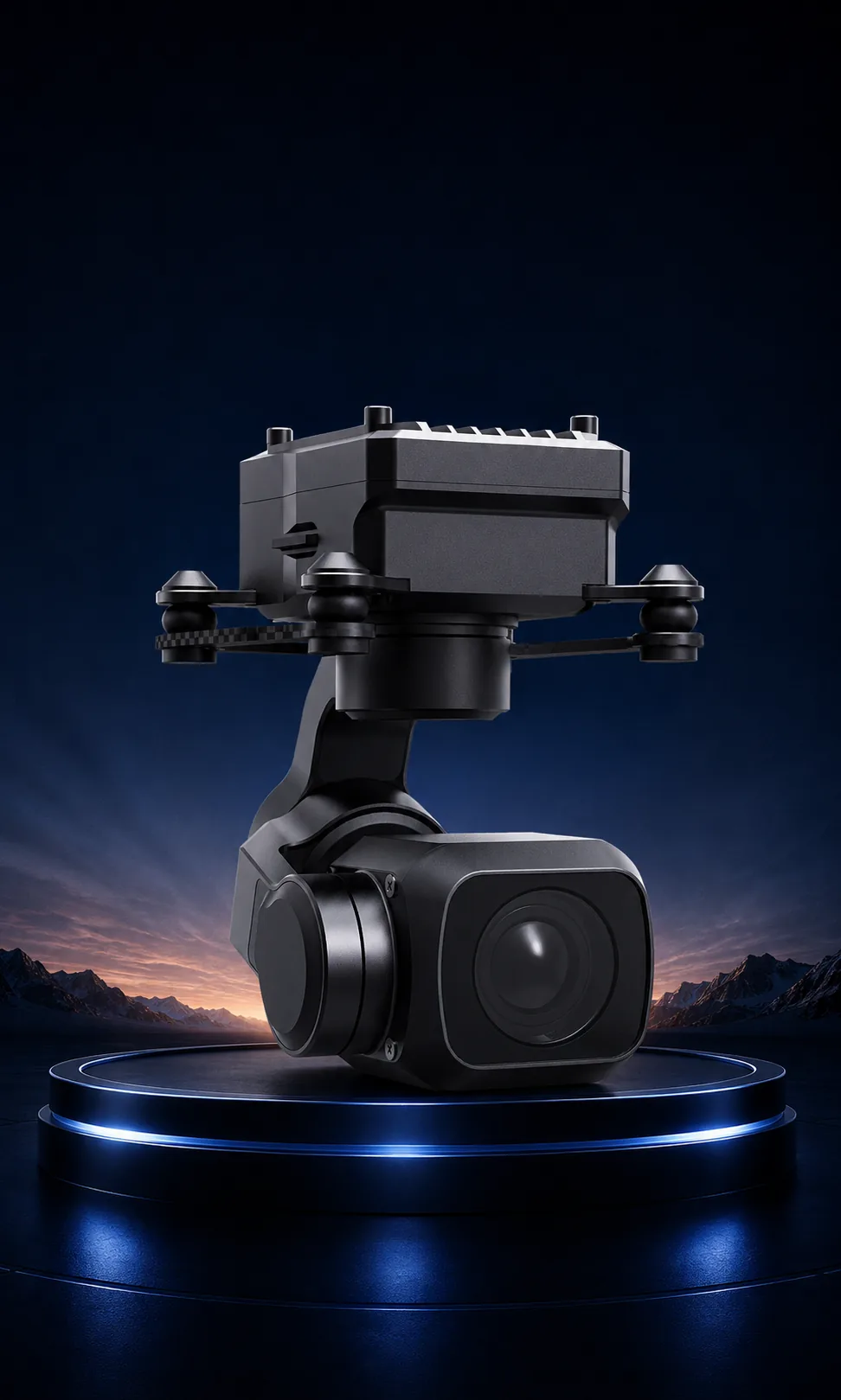
Detect on thermal, identify on starlight or NIR, and let AI tracking hold the target through the handoff. That sequence is the whole architecture of a serious night payload, and quad-sensor units like the MV-4X exist precisely for this workflow.
The handoff is the part that needs engineering rather than procedure. For a target detected on thermal to be found on the visible channel, the two have to be boresight-aligned — EO/IR fusion and boresight alignment — and for the operator not to lose it during the switch, tracking has to run across both channels, which AI target tracking covers.
In practice this is why police work insists on dual-sensor: identification before approach is an officer-safety requirement, and a thermal-only payload cannot supply it. Dual-channel display modes covers presenting both channels without mode-surfing at the critical moment.
Choosing on a Constrained Budget
If only one channel is affordable, the choice follows the job rather than the technology.
If detection is the job — search, patrol, wide-area monitoring — choose thermal. Finding something you did not know was there is the harder problem, and thermal is the only one of the three that solves it reliably in the dark.
If identification is the job — evidence collection, close observation of a known location, documentation — choose starlight. You already know where to look; you need to see detail.
The failure case is buying identification capability for a detection mission. A starlight-only payload flown on a search produces excellent imagery of wherever the operator happened to point it, and misses the subject fifty metres to the left. Choosing a payload without spec noise covers keeping this decision anchored to the mission.
Related reading
- Starlight and Low-Light Imaging: Seeing in 0.01 Lux Without Thermal
- NIR Laser Illumination: Invisible Floodlights for Night Zoom
- EO/IR Sensor Fusion and Boresight Alignment
- Why Thermal Cameras Live at 8–14 µm
- DRI Ranges Explained
- AI Target Tracking on UAV Payloads
- Thermal Drones in Law Enforcement
- PiP, Fusion and Split View
- MV-1P — 100 g starlight micro pod
- MV-4X — quad-sensor micro pod
- OP-80N — starlight and NIR identification
- OP-80A — low-light zoom with NIR
FAQ
Which single technology should a small budget pick?
If detection is the job — search, patrol, wide-area monitoring — choose thermal, because finding something you did not know was there is the harder problem and thermal is the only one of the three that solves it reliably in darkness. If identification is the job — evidence, close observation of a known location — choose starlight. The expensive mistake is buying identification capability for a detection mission.
Does rain or fog break these?
All three degrade in heavy precipitation, but not equally. Thermal handles light fog best, since long-wave infrared is scattered less than visible light by small droplets. NIR fares worst because the illuminator’s own light backscatters off the droplets straight into the sensor, producing a bright wall much like driving with high beams in fog. Starlight sits in between.
Can a subject defeat all three?
Solid cover defeats all three at once — buildings, vehicles, dense canopy — because none of them penetrate solid material. Beyond that they fail separately: darkness defeats starlight, distance defeats NIR illumination, and camouflage defeats the visible channels while leaving thermal untouched. That divergence is exactly the argument for stacking them rather than choosing between them.
Questions about the technology? Talk to our engineers — we reply within 2 business days.