

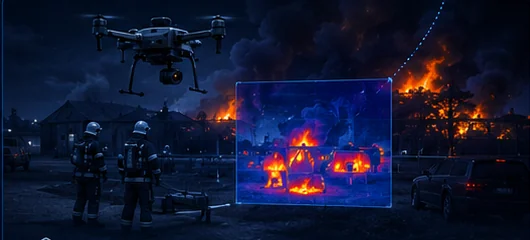
Successful public safety drone programs are built in stages — a patrol-launched aircraft with a dual-sensor payload delivers 80% of the mission value long before a drone-as-first-responder network is on the table.
- Stage 1Patrol launch, one aircraft per shift
- 80%Of value from the first stage
- 2 operatorsPer aircraft, trained in pairs
- 1 specStandardised across the fleet
Key takeaways
- Stage one proves value and builds flight culture. Skipping to DFR before that culture exists is the most common way programmes stall.
- One dual-sensor payload that flies every mission type beats specialised units at stage one, and keeps training and spares manageable.
- Specialised capability — starlight and NIR identification, coordinate handoff, tethered ONVIF overwatch — belongs at stage two, once the missions justify it.
- The biggest programme killer is not budget. It is a privacy incident, and policy discipline is far cheaper than rebuilding trust.
On this page
Stage One: Patrol Launch Capability
One aircraft per shift, a thermal and zoom payload, and trained operator pairs. That is the whole of stage one, and it is where the majority of the operational value lives.
The missions it covers are the ones agencies actually run most often: missing persons, suspect containment, scene overwatch, fireground support. None of them require a network, a rooftop launch box or a real-time crime centre integration. They require an aircraft that arrives quickly with a sensor that works in the dark — see thermal drones in law enforcement and firefighting thermal support.
What stage one is really building is flight culture. Operators who fly regularly develop judgement about altitude, lighting, weather and when not to launch, and that judgement is what makes later stages safe. A programme that buys sophisticated capability before this exists has expensive hardware operated by people learning on live incidents.
Train in pairs from the start. One flies the pattern, one watches the screen — the same discipline that SAR teams arrive at, for the same reason: split attention finds fewer people.
Stage Two: Specialised Capability
Once the base capability is routine, three additions earn their place — and notably, each is driven by a mission gap the first stage exposed rather than by a catalogue.
Night identification. Thermal detects, but confirming that the heat signature is your subject rather than a resident requires a low-light or illuminated channel. Starlight and NIR payloads like the OP-80N close that gap — starlight vs NIR vs thermal compares the approaches.
Coordinate handoff to ground units. A rangefinder-equipped payload turns an observation into a position that responders can navigate to, rather than a landmark description over the radio. Why an LRF belongs on your payload covers the chain and its error sources.
Tethered overwatch for events, with ONVIF integration into the real-time crime centre. This is where the drone stops being a handheld asset and becomes part of the fixed video infrastructure — see ONVIF and IP video on drone payloads and event and crowd safety.
Stage Three: DFR and Fleet Operations
Drone as first responder is a different kind of programme, not merely a larger one. Roof-launched response ahead of officers, VMS-integrated video, and documented response-time gains that justify the infrastructure.
The prerequisites are organisational as much as technical: waivers for beyond visual line of sight, a staffed launch and monitoring function, and an established relationship with the community that will notice aircraft launching routinely. Agencies that reached DFR successfully generally spent two stages earning those things.
Payload standardisation across the fleet keeps training and spares manageable. This is the point where the temptation to buy specialised units for specialised missions becomes expensive — every additional payload type multiplies spares inventory, training burden and the number of ways an unfamiliar unit behaves at 3 a.m. One multi-sensor payload or several cameras works through the trade.
| Stage | Capability | Payload strategy | What it proves |
|---|---|---|---|
| One | Patrol launch, one aircraft per shift | Single dual-sensor spec, thermal plus zoom | Operational value and flight culture |
| Two | Night ID, coordinate handoff, tethered overwatch | Add starlight/NIR and ranging where missions demand | Capability depth against specific gaps |
| Three | DFR, VMS integration, fleet operations | Standardise one spec across the fleet | Response-time gains and sustainable operations |
The Trust Infrastructure
Publish the use policy and flight logs, brief community groups, and hold the line on mission scope. Capability grows only as fast as legitimacy, and this is not a communications afterthought — it is the load-bearing structure of the programme.
The mechanics are unglamorous and cheap. A public document stating what the aircraft does and what is retained. Flight logs recording camera orientation as well as position, so “what were you looking at” has a documented answer. Automatic retention limits. A named contact for complaints. The privacy and regulation primer covers both rulebooks.
The most useful public-facing fact is technical: thermal does not see through walls or glass, only exterior surfaces. Most community objections assume a capability the physics does not provide, and correcting it early defuses more opposition than reassurance about policy ever will.
Holding the line on scope is the hardest part. A programme funded for missing persons will be asked to do something adjacent, and each request is individually reasonable. Programmes lose legitimacy to accumulated drift rather than to a single abuse, and “that is not what this is for” is a sentence worth practising.
Policy discipline is cheaper than rebuilding trust. A privacy incident does not usually end a programme outright. It imposes restrictions, consumes leadership attention, and makes every subsequent expansion harder — which amounts to the same thing more slowly.
Where Programmes Actually Stall
Three failure patterns recur, and none of them is about the aircraft.
- Buying stage-three capability at stage one. Sophisticated hardware operated by inexperienced crews produces incidents, not capability.
- One qualified pilot. A programme that depends on a single person has a capability that disappears when they are on leave, and no path to a second shift.
- Fleet fragmentation. Three payload types bought for three missions triples the spares, training and failure modes for marginal gain.
- Deferring the policy work until someone complains. By then the conversation is defensive rather than informative.
- No documented outcomes. A programme that cannot show what it achieved is the first line cut in a tight budget year.
That last point deserves emphasis. Record the finds, the response times, the searches concluded early and the officers not sent into unknown yards. A programme with a documented record of outcomes survives budget scrutiny; one that everybody agrees is useful but cannot prove it does not. The same discipline that produces defensible inspection deliverables applies here in a different register.
Related reading
- Onboard AI Inference Architecture
- Starlight and Low-Light Imaging
- Thermal Drones in Law Enforcement
- Thermal Drones, Privacy and Regulation
- ONVIF and IP Video on Drone Payloads
- One Multi-Sensor Payload or Several Cameras?
- Starlight vs NIR vs Thermal
- The SAR Drone Team Equipment Checklist
- OP-80N — starlight and NIR identification
- OP-90A — dual-sensor with ranging
- MV-4X — micro quad-sensor for patrol launch
- Thermal Drone Payloads for Search and Rescue
FAQ
What payload spec for a first programme aircraft?
Dual-sensor, 640×512 thermal, 30x-class zoom, AI tracking — one payload that flies every mission type beats specialised units at stage one. The reasoning is operational rather than technical: a single spec means one set of spares, one training syllabus, and one set of behaviours for operators to know cold. Specialised capability is worth buying once a specific mission gap has proven itself, not in anticipation of one.
What is the biggest programme killer?
Not budget — a privacy incident. Policy discipline is cheaper than rebuilding trust, and the damage is rarely a single dramatic shutdown. What usually happens is restrictions, leadership attention consumed, and every subsequent expansion becoming harder to justify. Publishing a use policy, logging camera orientation and holding the line on mission scope cost almost nothing by comparison.
How long should each stage take?
Long enough that the capability is routine before the next one is added, which is a judgement rather than a calendar. The useful test for readiness is whether crews handle the current missions without improvising — if launches still involve figuring things out, the programme is not ready for more complexity. Agencies that reached DFR successfully generally spent meaningful time at stages one and two building the flight culture and community relationship that DFR depends on.
Questions about the technology? Talk to our engineers — we reply within 2 business days.