

IP67 promises two things only: total dust ingress protection (6) and survival of 30-minute immersion at 1 m depth (7). It says nothing about salt fog, condensation cycling, or flying through rain at 15 m/s — read it as a baseline, not a weather licence.
- 6Dust-tight, first digit
- 730 min at 1 m immersion
- −20 to 50 °CPublished operating range
- ≤85% RHNon-condensing
Key takeaways
- The first digit covers solids, the second water. Neither says anything about corrosion, condensation or airflow-driven rain.
- Payloads with moving gimbal axes earn these ratings through labyrinth seals and coated boards — much harder than sealing a static box.
- Salt-mist corrosion, condensation from altitude and temperature swings, lens fogging and connector mating cycles are all outside the rating.
- Weather tolerance is a system property. Aircraft, payload and mount all have to survive the same conditions.
On this page
Decoding the Digits
An IP rating is two independent numbers. The first digit covers solids: 6 means dust-tight, total protection against ingress. The second covers water: 5 means protection against jets, 6 against heavy seas, 7 against temporary immersion to 1 m for 30 minutes.
Note that the water scale is not strictly cumulative in the way people assume. A device rated for immersion has been tested static in still water; that is a different test from sustained pressurised jets, which is why some equipment carries two ratings. Neither test involves an object moving through rain at flight speed.
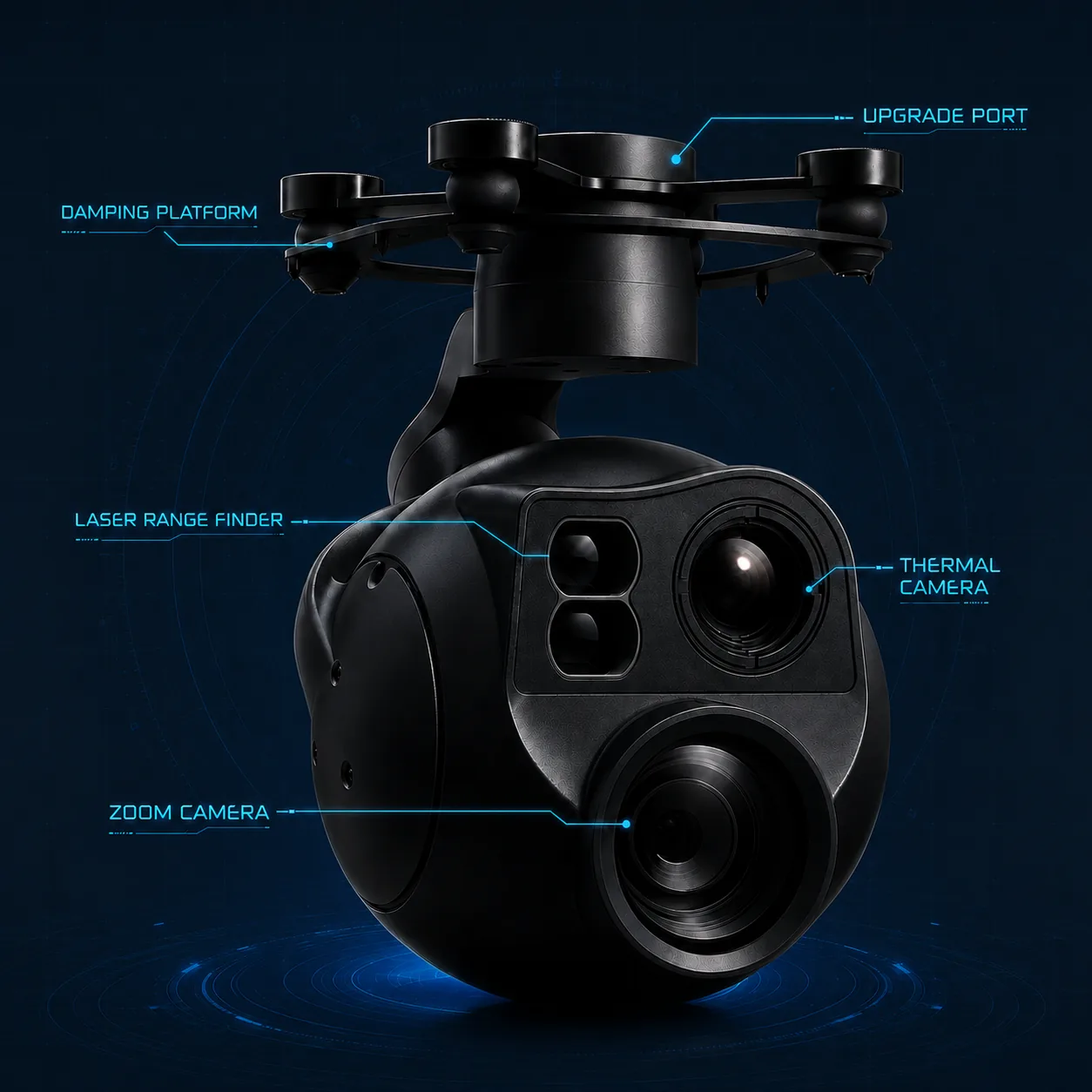
Payloads with moving gimbal axes earn these ratings through labyrinth seals and conformally coated boards, which is materially harder than sealing a static box. Every axis is a rotating joint that has to exclude water while moving freely across its full travel — one reason a sealed gimbal costs more than a sealed camera.
What Ratings Do Not Cover
Four failure modes sit entirely outside the IP scheme, and between them they account for most real-world environmental damage to payloads.
| Not covered by IP | What actually happens | What to ask instead |
|---|---|---|
| Salt-mist corrosion | Connectors and coatings degrade over months | Is there a separate salt-fog test result? Conformal coating? |
| Condensation cycling | Rapid altitude or temperature change condenses moisture inside | How is the housing vented or desiccated? |
| Lens fogging | Optics fog moving from warm vehicle to cold air | Acclimatisation guidance; heated optics on some units |
| Connector mating cycles | Seals wear with repeated connect and disconnect | Rated mating cycles for the connector used |
| Rain at airspeed | Impact-driven water finds paths still water does not | Any wind-driven rain testing at all? |
Coastal and maritime operators should ask about conformal coating and connector sealing specifically, because salt is the slow killer — a payload performs normally for months and then develops intermittent faults that are difficult to diagnose. Maritime and overwater operations covers the exposure, and gimbal camera maintenance covers the rinse-and-inspect routine that extends service life.
The Published Operating Envelope
IP is only one part of the environmental specification, and the temperature and humidity limits are often more operationally relevant. Across the UAVThermal line these are consistent.
| Parameter | Published value |
|---|---|
| Operating temperature | −20 °C to +50 °C |
| Storage temperature | −40 °C to +60 °C |
| Operating humidity | ≤85% RH, non-condensing |
The phrase that does the most work there is non-condensing. An aircraft climbing from warm humid ground into cold air, or descending back into it, passes through conditions where moisture condenses on and inside cold surfaces — and that is outside the specification even though the humidity number was never exceeded. Cold-weather operations covers the acclimatisation practice that manages it.
The −20 °C lower limit is also worth planning against honestly. It is the payload limit; battery performance degrades well before that, so in practice the aircraft usually constrains the mission before the pod does.
Mission Reality Check
Rated protection keeps spray, dust and brief rain from ending a mission. That is a real and valuable thing — an unrated payload caught in a shower is a maintenance event, and a rated one is an inconvenience.
What sealing does not do is preserve image quality. Optics still degrade with water on glass, and thermal accuracy shifts with a wet lens because the water film is itself an emitting surface between the sensor and the scene. A sealed payload flying in rain is protected and not necessarily useful — what actually still works in fog, rain and humidity covers the imaging side.
Weather tolerance is a system property: aircraft, payload and mount together. A sealed pod on an aircraft with unsealed motors buys nothing, and a well-sealed system with an exposed connector at the mount interface fails at the connector. Assess the weakest element rather than the best-specified one.
IP is a survival rating, not a performance rating. It tells you the payload will still work after the exposure. It says nothing about whether the imagery during that exposure is worth collecting.
Matching the Rating to the Environment
Higher is not automatically better, which surprises people. Sealing adds mass, and it complicates thermal management — a sealed housing cannot shed heat by airflow, so a tightly sealed payload running a rangefinder and illuminator has to move that heat some other way.
- Characterise the actual environment: dust, precipitation, salt, temperature range and how fast it changes.
- Match the rating to that environment rather than maximising digits, and check mass against your payload budget.
- Ask separately about salt-fog testing and conformal coating if any part of the operation is coastal.
- Confirm the connector rating and mating-cycle life, because that is where sealed systems most often leak.
- Check the whole system — aircraft and mount as well as pod — against the same conditions.
For most inland inspection work a well-sealed payload within the published temperature envelope is entirely sufficient, and the mass saved is better spent on thermal resolution or endurance. For marine, mining and all-weather public-safety work, sealing is where the money should go — see what drives payload price.
Related reading
- Payload Mechanical Integration: Mounts, Damping and Balance
- Thermal Infrared Optics
- Cold-Weather Thermal Drone Operations
- Thermal Drones in Fog, Rain and Humidity
- Maritime SAR and Overwater Operations
- Gimbal Camera Maintenance
- What Drives the Price of a UAV Thermal Payload
- UAV Payload Integration Checklist
- LX-9B — multi-sensor pod
- OP-90P — multi-sensor pod with ranging
- MV-2P — 640×512 thermal at 130 g
- Mining and Quarry Drone Monitoring
FAQ
Is a higher IP rating always better on a payload?
No. Sealing adds mass and complicates thermal management, since a sealed housing cannot shed heat through airflow. Match the rating to the operating environment rather than maximising digits — for inland inspection work a moderate rating within the published temperature envelope is sufficient, and the mass saved buys more useful capability elsewhere. For marine and all-weather operations, sealing is exactly where the budget belongs.
Does an unrated payload mean fair-weather only?
Effectively yes for professional planning. Treat unrated hardware as dry-conditions equipment and schedule around weather rather than hoping. The absence of a rating usually means the testing was not done rather than that the payload failed it, but from a planning perspective the distinction does not help you — an untested seal is an unknown, and unknowns belong on the ground when it rains.
What should coastal operators ask beyond the IP number?
Salt-fog test results and whether the boards are conformally coated, because salt-mist corrosion is a separate test regime that IP does not touch. Also ask about the connector: rated mating cycles and whether the mount interface is sealed, since that junction is where otherwise well-sealed systems most often admit moisture. Then budget for a post-flight freshwater rinse routine, which extends service life more than any specification.
Questions about the technology? Talk to our engineers — we reply within 2 business days.