
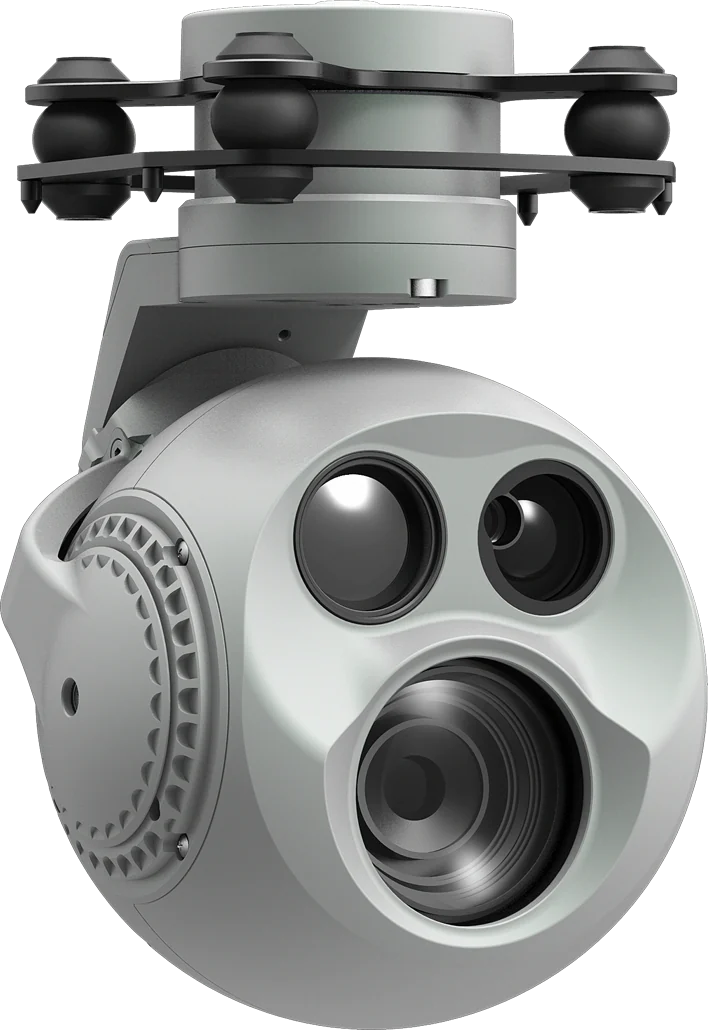
A stabilised zoom payload documents bearing condition, weld details and cable anchorages from below the deck without a snooper truck or lane closure — and thermal screening flags deck delamination before coring crews arrive.
- ±0.01°Pointing accuracy on inspection pods
- +70°Upward pitch travel, OP-80P
- ±360°Continuous yaw
- 640×512Thermal for deck screening
Key takeaways
- Drones replace access equipment wherever access cost dominates inspection cost — under-deck girders, pier caps, cable anchorages, high steel.
- Delaminated concrete heats and cools differently from sound deck, so a midday thermal pass concentrates physical testing where it matters.
- Upward gimbal travel is the specification that decides whether under-deck work is possible at all; most payloads are built to look down.
- Priorities in order: gimbal travel range, zoom sharpness, low-light response under decks, stabilisation against pier turbulence, and ranging for element position tagging.
On this page
Where Drones Replace Access Equipment
Under-deck girders and bearings, pier caps, cable stays and anchorages, high steel connections — anywhere access cost dominates inspection cost. That is the whole economic case, and it is unusually clean: a snooper truck plus a lane closure plus a traffic management plan is a five-figure day before anyone has looked at a bearing.
Zoom from a stable hover replaces rope and bucket time. The inspector stays on the ground, the traffic stays moving, and the imagery is recorded rather than transcribed from a clipboard at height. For routine condition documentation this is simply a better product, not merely a cheaper one — a bearing photographed at 10x optical from a stationary hover is more legible than the same bearing viewed by someone hanging next to it.
The pattern generalises to other tall structures where standoff beats access: telecom towers, dams and levees, and the bridge and tunnel application page covers the commercial case in more depth.
Thermal’s Role: Deck Screening
Delaminated concrete heats and cools differently from sound deck. A void beneath the surface interrupts conduction into the mass below, so the delaminated area warms faster under sun and cools faster afterwards than intact deck around it. Midday thermal passes flag candidate zones so physical testing concentrates where it matters.
The value here is not that thermal replaces sounding or coring — it does not. The value is that it turns a systematic full-deck survey into a targeted one. Chain-dragging an entire deck is slow and requires the closure the drone was supposed to avoid; chain-dragging six flagged zones is an afternoon.
Timing is the whole technique. The signature depends on differential heating, so a pass flown at the wrong hour finds nothing on a deck full of delamination. Midday and early afternoon during a clear day give the strongest signal; an overcast day may give none at all.
Asphalt overlays complicate, but do not eliminate, the signature. An overlay adds thermal mass between the void and the surface, damping and delaying the signature rather than removing it. Survey timing and baseline comparison against known-sound areas matter more on overlaid decks than on bare concrete.
Specification Priorities
Bridge work inverts the usual payload priorities. The camera matters less than the mount, because the constraint is geometry rather than image quality.
| Priority | What to check | Why bridge work makes it critical |
|---|---|---|
| Gimbal travel range | Upward pitch travel, continuous yaw | Under-deck work looks up; most payloads are built to look down |
| Zoom sharpness | Optical factor and sensor resolution | Weld and bearing detail lives in the optical share, not the digital |
| Low-light response | Published minimum illumination | Under a deck is shaded even at midday |
| Stabilisation | Pointing accuracy under load | Pier turbulence and channel wind are worse than open-air hover |
| Ranging | LRF availability and accuracy | Distance-tags each finding to a specific element for the report |
Upward travel deserves the top slot because it is binary: a payload that cannot look up cannot do under-deck work at any price. The OP-80P publishes pitch travel from −157° to +70° with continuous ±360° yaw, which covers the upward-look geometry. Compare that with pods whose pitch stops near horizontal.
Payload Options
Three configurations cover most bridge programmes, and the choice turns on whether you need thermal in the same flight.
| Payload | Zoom | Thermal | Pointing accuracy | Pitch travel |
|---|---|---|---|---|
| OP-80P | 10x optical / 40x hybrid, 4K | — | ±0.01° | −157° to +70° |
| OP-90A | 10x optical / 30x hybrid | 640×512, <50 mK | ±0.01° | −150° to +50° |
| AX-200T | Camera-dependent | Camera-dependent | ±0.01° | −135° to +40° |
The OP-80P brings 4K capture and ONVIF output, which matters when the imagery feeds an inspection recording system rather than a pilot’s screen — see ONVIF and IP video on drone payloads. The OP-90A adds a 640×512 thermal channel so deck screening and detail documentation happen in the same flight. The AX-200T is the stabilisation platform for builds where you are supplying the camera, at the same ±0.01° class.
The “40x” and “30x” figures are hybrid, not optical. The OP-80P is 10x optical with 4x digital on top; the OP-90A is 10x optical with 3x digital. Only the optical share adds real detail — see hybrid zoom explained before writing a zoom requirement into a specification.
Flying Under Decks
Under-deck flight is GPS-denied or GPS-degraded almost by definition — the structure is between the aircraft and the satellites. This is an aircraft capability question rather than a payload one, and it is answerable: position-hold-capable aircraft using visual or lidar odometry handle it routinely.
What the payload has to contribute is upward gimbal travel and good low-light response, because the space is shaded and the subject is overhead. Published minimum illumination figures are worth checking against the actual conditions; a pod rated for night vision at 0.001 lux has ample margin under a deck at noon, while a daylight-only camera may not.
Pier turbulence is the third factor and the least predictable. Wind accelerating around piers and through the channel produces gusts that a stabilised gimbal has to absorb while holding a long-lens shot. This is where pointing accuracy stops being a datasheet number and becomes the difference between a usable bearing photograph and forty blurred frames — and wind, vibration and exposure covers the flight factors in general.
What It Does Not Replace
Worth stating plainly, because overselling this capability damages programmes. Visual and thermal drone inspection is a screening and documentation tool. It does not replace hands-on inspection where code requires it, it does not sound concrete, it does not measure section loss on a corroded member, and it does not get inside a box girder without an aircraft specified for confined space.
What it does is change the ratio. A programme that previously closed lanes to inspect everything can now close lanes to inspect the flagged ten percent, with photographic documentation of the rest. That is a large saving and a better record, and it is a more durable claim than pretending the snooper truck is obsolete.
The failure case worth naming: relying on a zoom image to grade a defect that needs tactile assessment. A crack width judged from 40 m of standoff through atmospheric shimmer is an estimate, and reporting it as a measurement is how a drone programme loses credibility with the engineers who have to sign the assessment.
Related reading
- Gimbal Stabilization Technology: How ±0.01° Steadiness Is Achieved
- Continuous Zoom Optical Blocks: What 10x to 40x Costs
- Hybrid Zoom on UAV Cameras: What 120x or 1500x Actually Means
- What ±0.01° Gimbal Accuracy Means at 1,000 Metres
- ONVIF and IP Video on Drone Payloads
- The Complete Guide to Drone Inspections
- Wind, Vibration and Exposure: The Flight Factors That Decide Image Quality
- OP-80P — 4K spherical pod with ONVIF output
- OP-90A — zoom and thermal multi-sensor pod
- AX-200T — ±0.01° 3-axis gimbal
- Bridge and Tunnel Inspection Drones
- Telecom Tower Drone Inspection
FAQ
Can drones inspect under decks in GPS-denied space?
Yes, with position-hold-capable aircraft — visual or lidar odometry handles the loss of satellite position that a deck overhead guarantees. That is an airframe capability rather than a payload one. What the payload must supply is upward gimbal travel, since the subject is overhead and most pods are built to look down, and good low-light response, because the space under a deck is shaded even at midday.
Does thermal deck screening work on asphalt overlays?
Overlays complicate the signature but do not eliminate it. The added thermal mass between the void and the surface damps and delays the temperature difference, so the contrast is weaker and appears later in the heating cycle. Survey timing and comparison against a known-sound baseline area matter considerably more on an overlaid deck than on bare concrete — and an overcast day may yield no usable signature at all.
What zoom factor does bridge inspection actually need?
Read the optical figure, not the hybrid one. Most bearing, weld and anchorage documentation is comfortable at 10x optical from realistic standoff, and the digital multiplier on top adds framing convenience rather than detail. A specification written around a hybrid number invites bids where the optical share is small, which is exactly the detail that matters for defect documentation.
Questions about the technology? Talk to our engineers — we reply within 2 business days.