

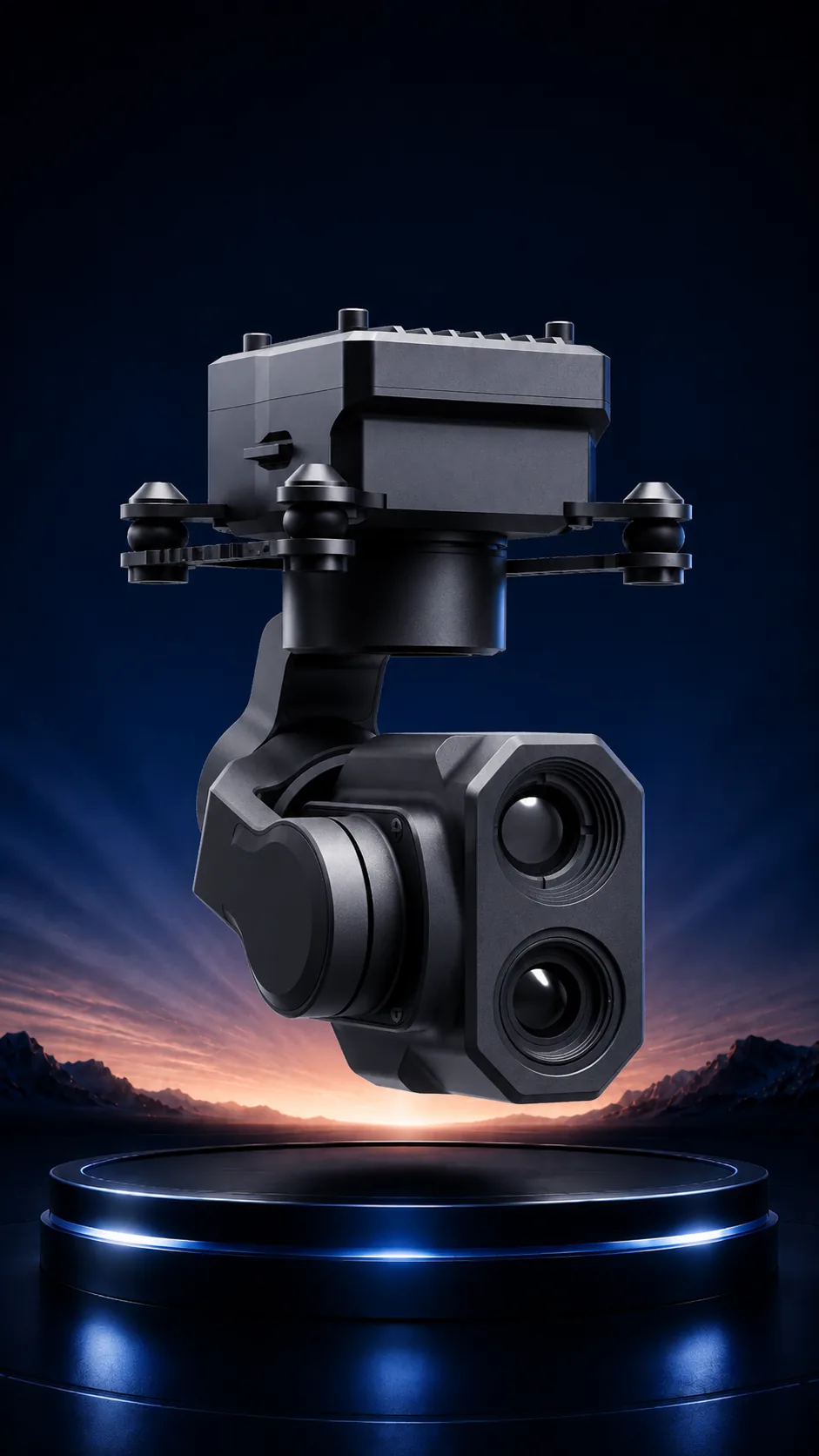
Focal length is the other half of thermal performance: the same 640×512 core detects a person at roughly 400 m with a wide short lens but around 1,000 m with a 25 mm lens — while the wide lens searches four times the area per pass.
- 4xArea advantage of a wide lens
- 2.5xRange advantage of a narrow one
- GermaniumWhat thermal lenses are made of
- FactoryWhen lens choice is fixed
Key takeaways
- Longer focal length means more pixels on a distant target and more range; shorter means a wider field of view and faster coverage. One fixed lens cannot give both.
- Area search and mapping favour wide optics; corridor patrol and standoff observation favour narrow.
- Focal length is meaningless without resolution and pixel pitch — a range claim needs all three to be interpretable.
- On integrated stabilised payloads the lens is a factory configuration. Specify against your longest-range mission.
On this page
The Trade in One Sentence
Longer focal length equals more pixels on a distant target equals more range. Shorter focal length equals a wider field of view equals faster area coverage. You cannot have both in one fixed lens, and every thermal payload specification is a decision about where on that line to sit.
The arithmetic is unforgiving in both directions. Doubling focal length roughly halves the linear field of view, which quarters the ground area covered per frame — so the narrow lens that reaches twice as far searches a quarter as much ground per pass. Conversely the wide lens that covers four times the area detects at roughly half the distance.
This is why the same core produces such different published ranges in different configurations, and why comparing two payloads on detection range alone tells you almost nothing about which is better for your mission.
Match Lens to Mission
The mapping is reasonably clean once the trade is explicit.
| Mission | Lens preference | Why |
|---|---|---|
| Area search (SAR, wildlife) | Wide | Ground covered per battery dominates find probability |
| Mapping and survey | Wide | Overlap and coverage are the deliverable |
| Corridor patrol (pipeline, powerline) | Narrow | The corridor is linear; reach along it is what matters |
| Standoff observation and security | Narrow | Range keeps the aircraft outside notice or hazard |
| Roof and facade inspection | Middle | Close working distance, moderate area |
| Fireground | Middle | Scene-scale coverage with usable detail |
| Mixed mission set | Zoom or dual thermal | A single fixed lens compromises everything |
That last row is the practical answer for most programmes. If missions vary, choose the payload class with zoom or dual thermal options rather than compromising on one fixed lens — a compromise lens is by construction wrong for both ends of your mission set. One multi-sensor payload or several cameras covers the wider version of this trade.
Reading a Spec Sheet Correctly
Check focal length together with sensor resolution and pixel pitch. “Detects vehicle at 3 km” means nothing without all three, because the quantity that actually determines detection is angular resolution per pixel, and that depends on pitch divided by focal length.
Two payloads with identical focal lengths perform differently if their pixel pitches differ, and two with identical pitch differ if the focal lengths do. A 12 µm core behind a given lens resolves finer angular detail than a 17 µm core behind the same lens — why 12 µm replaced 17 µm covers that half.
Detection also differs from identification by roughly a factor of four, so a headline detection figure describes a capability well short of what most missions actually need. Plan on recognition or identification range — DRI ranges explained covers the thresholds and the two competing standards, which differ by roughly an order of magnitude for the same hardware.
Three numbers or none. Resolution, pixel pitch and focal length. A range claim quoting fewer than all three is not comparable to any other range claim, and asking for the missing ones is a reasonable request that good suppliers answer immediately.
Why the Optics Are Small and Expensive
LWIR optics use germanium, not glass, because glass is opaque at 8–14 µm. Germanium is the inverse — opaque to visible light, transparent in the thermal band — and it is dense, costly and requires anti-reflection coating to transmit efficiently.
Thermal cores are also low-resolution relative to visible sensors, so the apertures stay compact compared with a photographic lens of similar reach. That is why a thermal lens looks so much smaller than a visible zoom block covering equivalent ground.
But compact does not mean cheap. Germanium volume is a dominant cost and mass driver in every thermal payload, and it scales badly with focal length — a longer lens needs more of an expensive material, precisely figured and coated. Germanium lenses, f/1.0 apertures and athermalisation covers the design constraints, and what drives payload price puts it alongside the other cost drivers.
Aperture speed matters as much as focal length and is quoted less. A fast f/1.0 lens gathers substantially more energy than a slower one, which is why NETD figures are often published with an f-number attached — a sensitivity claim at f/1.0 with a slower lens fitted is not the sensitivity you get.
The Decision Is Permanent
On integrated stabilised payloads, the lens cannot be changed later. It is a factory configuration, chosen when the pod is built and sealed into an assembly that also has to hold boresight alignment and survive vibration.
That makes it one of a small set of genuinely irreversible payload decisions, alongside radiometric calibration and link variant. Everything else can be worked around; these three cannot.
Specify against your longest-range mission requirement rather than your most common one. The reasoning is asymmetric: a narrow lens flown on a wide-area mission costs extra passes and extra batteries, which is expensive but possible. A wide lens flown on a long-range mission simply cannot see the target, and no amount of extra flying fixes it.
- List the missions and identify the one with the greatest required detection distance.
- Work backwards from the target size and required DRI level to the angular resolution you need.
- Check that against candidate configurations using resolution, pitch and focal length together.
- If the range and coverage requirements are irreconcilable, price a zoom or dual-thermal payload rather than compromising.
Related reading
- Thermal Infrared Optics: Germanium Lenses, f/1.0 Apertures and Athermalization
- From NETD to DRI
- DRI Ranges Explained
- Thermal Pixel Pitch: Why 12 µm Replaced 17 µm
- 256×192 vs 640×512 Resolution
- How Far Can a Drone Thermal Camera Detect a Person?
- What Drives the Price of a UAV Thermal Payload
- Hybrid Zoom on UAV Cameras
- MV-2P — 640×512 thermal at 130 g
- OP-125A — 30x optical multi-sensor pod
- LX-9B — multi-sensor pod with ranging
- Pipeline Monitoring UAV Payloads
FAQ
Why do thermal lenses look so small?
LWIR optics use germanium rather than glass, and thermal cores are low-resolution relative to visible sensors, so apertures stay compact for a given reach. The small size is misleading about cost, though — germanium is dense, expensive and must be precisely figured and anti-reflection coated, which makes lens volume a dominant cost and mass driver in every thermal payload.
Can I change the lens later?
On integrated stabilised payloads, no — lens choice is a factory configuration sealed into an assembly that must also hold boresight alignment and survive vibration. Specify against your longest-range mission requirement rather than your most common one. A narrow lens on a wide-area mission costs extra passes; a wide lens on a long-range mission cannot see the target at all, and no amount of extra flying recovers that.
How much range does a longer lens actually buy?
Roughly in proportion to focal length, at the cost of field of view squared. Doubling focal length approximately doubles detection distance and quarters the ground area covered per frame. Whether that trade is worth it depends entirely on whether your mission is bounded by how far you can see or by how much ground you can cover — and those two are rarely the same constraint.
Questions about the technology? Talk to our engineers — we reply within 2 business days.