

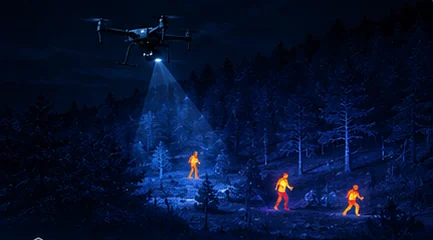
How far a drone thermal camera can detect a person depends on far more than sensor resolution. Across six current UAVThermal payloads, published Johnson-criteria figures put person detection between 379 m and 1,042 m for the same 640×512, 12 µm core — a 2.75× spread — and one 256×192 unit actually outranges a 640×512 model. The variable that moves the number is the lens field of view, not the pixel count.
- 379–1,042 mSpread on one core
- 2.75×Ratio between extremes
- 13 vs 37Pixels per degree
- ~50%Common planning margin
Key takeaways
- Six payloads, one 640×512 core, and a 2.75× spread in published person detection range — driven by lens field of view.
- Johnson criteria count pixels across the target, so pixel density per degree of view is the governing quantity.
- A 256×192 unit with a narrow lens outranges a 640×512 unit with a wide one. Resolution is not the range number.
- A detection figure without a stated field of view is not comparable to anything.
On this page
Person Detection Range: Six Payloads Compared
All figures below are manufacturer spec-sheet values for a person-sized target under Johnson criteria: detection (something warm is there), identification (it is a human), verification (details of the person). See our DRI explainer for how these thresholds are defined and why a second standard, EN 62676-4, gives figures roughly an order of magnitude smaller for the same hardware.
| Payload | Thermal core | Thermal HFOV | Detect | Identify | Verify |
|---|---|---|---|---|---|
| MV-2M | 256×192, 12 µm | 17.5° | 417 m | 188 m | 94 m |
| MV-2P | 640×512, 12 µm | 48.3° | 379 m | 95 m | 47 m |
| OP-90A | 640×512, 12 µm | 24° | 750 m | 188 m | 94 m |
| OP-90P | 640×512, 12 µm | 22.9° | 750 m | 188 m | 94 m |
| OP-125A | 640×512, 12 µm | 17.5° | 1,042 m | 260 m | 130 m |
| LX-9B | 640×512, 12 µm | 17.5° | 1,042 m | 260 m | 130 m |
Read down the core column and then down the detect column. Five payloads share an identical 640×512, 12 µm sensor and their detection figures run from 379 m to 1,042 m. Whatever is producing that spread, it is not the detector.
Why Identical 640×512 Cores Span 379 m to 1,042 m
Johnson criteria count pixels across the target. How many pixels a person occupies at a given distance is set by pixel density per degree of view — resolution divided by field of view.
The MV-2P spreads 640 pixels across a wide 48.3° lens: about 13 pixels per degree. The OP-125A and LX-9B concentrate the same 640 pixels into 17.5°: about 37 pixels per degree. That ratio — 2.75× — matches the published detection figures exactly: 1,042 m ÷ 379 m = 2.75.
The same relationship can be written as IFOV, the instantaneous field of view of one pixel: pixel pitch divided by focal length. A 12 µm pixel behind the MV-2P’s 9.1 mm lens sees 1.32 mrad — roughly a 40 cm square at 300 m, so a standing person is only a couple of pixels tall. Behind the OP-90P’s 19 mm lens the same pixel sees 0.63 mrad, and a 17.5°-class telephoto tightens that to roughly 0.48 mrad — a 14 cm square at 300 m.
More about lens choice in our thermal focal length guide, and about the detector side in pixel pitch.
When 256×192 Outranges 640×512
The counterintuitive row in the table: the 256×192 MV-2M detects a person at 417 m while the 640×512 MV-2P is rated at 379 m.
The MV-2M pairs its small core with a narrow 17.5° telephoto lens, giving about 14.6 pixels per degree, while the MV-2P’s 48.3° wide lens yields about 13.3 px/°. Slightly more pixels land on the target, so the smaller sensor reaches farther.
That does not make the MV-2M the better camera — it makes it a different tool. The MV-2P images a swath nearly three times wider on every pass: far better situational awareness and area coverage, at the cost of reach. For a search pattern, swath width is often worth more than detection distance, because coverage per battery is what determines whether the subject was ever in frame.
Resolution still matters for image quality and wide-area work; it just is not the number that sets detection range. Our 256×192 vs 640×512 comparison covers the weight and budget side of that decision, and is 640×512 worth it covers platform fit.
Resolution is not the range number. If someone quotes a detection distance and offers resolution as the justification, they have skipped the variable that actually governs it. Ask for the field of view.
Reading DRI Numbers Before You Buy
Three habits keep spec-sheet comparisons honest.
- Compare the same line. A vendor’s “detection” distance can be four times its “verification” distance for the same camera, so a detection figure set against someone else’s identification figure is not a comparison.
- Check that pixel pitch and HFOV are stated. A detection figure without a field of view is not comparable to anything, and the omission is usually not accidental.
- Check which standard is named. Johnson criteria and EN 62676-4:2015 differ by roughly an order of magnitude for identical hardware.
- Treat every figure as a clear-atmosphere best case, and plan around a working margin.
On that last point: humidity, rain and fog attenuate long-wave infrared, so many operators plan missions around half the published detection distance as a working margin. Fog, rain and humidity limits covers the derates by condition — roughly 70–80% of spec in light haze, 50% in steady rain, and unreliable beyond a few hundred metres in fog.
And plan search missions on recognition or identification range rather than detection. Detecting an unclassified warm object generates a contact somebody has to resolve; the identify column in the table above is a far better basis for lane spacing than the detect column.
Choosing From This Data
The table maps onto missions fairly directly once you know whether you are constrained by reach or by coverage.
| Mission constraint | Choose | From the table |
|---|---|---|
| Maximum reach on a known bearing | Narrow HFOV, 640 core | OP-125A or LX-9B at 17.5° |
| Balanced reach and coverage | Mid HFOV, 640 core | OP-90A or OP-90P at 22.9–24° |
| Wide-area situational awareness | Wide HFOV, 640 core | MV-2P at 48.3° |
| Reach on a minimum-mass aircraft | Narrow HFOV, 256 core | MV-2M at 17.5°, 110 g |
Note that the MV-2M row is a genuine option rather than a curiosity — 417 m person detection in a 110 g package is a real capability for a light aircraft, and it outranges the heavier wide-lens alternative. Sub-250 g payloads covers that class.
For the method behind turning this into a purchase decision, see choosing a payload without spec noise.
Related reading
- From NETD to DRI: How Thermal Detector Performance Is Calculated
- Thermal Infrared Optics
- DRI Ranges Explained
- Thermal Lens Focal Length on Drones
- 256×192 vs 640×512 Resolution
- Is 640×512 Worth It?
- Thermal Drones in Fog, Rain and Humidity
- Search Patterns for Thermal Drone SAR
- MV-2M — 417 m person detection at 110 g
- OP-125A — 1,042 m person detection
- LX-9B — 1,042 m person detection
- Thermal Drone Payloads for Search and Rescue
FAQ
How far can a drone thermal camera detect a person?
Across six current UAVThermal payloads, published Johnson-criteria person detection runs from 379 m to 1,042 m — and five of those six share the same 640×512, 12 µm core. The spread comes from lens field of view rather than sensor resolution. Under the more conservative EN 62676-4:2015 standard the same hardware produces figures roughly an order of magnitude smaller, so always check which standard a claim uses.
Why does a 256×192 payload outrange a 640×512 one?
Because detection range is governed by pixel density per degree of view, not by total pixel count. The MV-2M pairs its 256×192 core with a narrow 17.5° lens for about 14.6 pixels per degree; the MV-2P spreads 640 pixels across a 48.3° lens for about 13.3 px/°. Slightly more pixels land on the target, so the smaller sensor reaches marginally farther — while the MV-2P covers nearly three times the swath per pass.
How much should I derate published detection figures?
Many operators plan around half the published detection distance as a working margin, and that is a reasonable default. More precisely: roughly 70–80% of spec in light haze, about 50% in steady rain, and unreliable beyond a few hundred metres in fog. Also plan search missions on the identification column rather than the detection column, since an unclassified warm contact still requires someone to go and check it.
Questions about the technology? Talk to our engineers — we reply within 2 business days.