
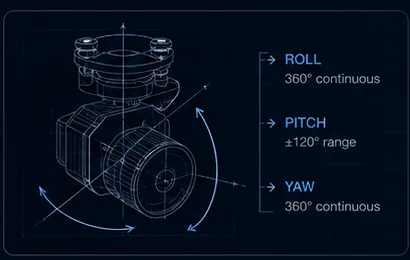
Each gimbal axis removes one class of aircraft motion from your image: roll smooths horizon tilt, pitch holds framing through speed changes, yaw absorbs heading corrections. Professional imaging payloads standardise on 3-axis for one reason — zoom magnifies every vibration you failed to remove.
- 1 axisPitch only — AX-20S
- 2 axesPitch and roll — AX-40D
- 3 axesAdds yaw decoupling
- ±0.01°Accuracy class on 3-axis pods
Key takeaways
- Roll removes horizon tilt, pitch holds framing through acceleration, yaw decouples camera pointing from aircraft heading.
- Yaw is the axis that makes tracking and inspection work, because without it the image swings every time the airframe turns.
- Axis count and pointing accuracy are separate specifications — a 3-axis mount with poor accuracy is still poor at zoom.
- Electronic stabilisation crops and warps. It supplements wide-angle video and cannot substitute for mechanical axes on zoom optics or thermal sensors.
On this page
What Each Axis Does
Roll-only or pitch-only (1-axis) suits FPV footage where some motion is aesthetic. The single axis removes the most objectionable component — usually horizon tilt or camera droop — and leaves the rest, which on a cinematic FPV flight is part of the look rather than a defect.
Adding pitch (2-axis) keeps subjects framed during acceleration. A multirotor pitches forward to move, so without pitch compensation the camera tips toward the ground every time the aircraft speeds up. Two axes give you a stable horizon and consistent framing, which covers general imaging and light inspection.
Adding yaw (3-axis) decouples camera pointing from aircraft heading — and this is the one that changes what missions are possible. With yaw stabilised, the operator can hold a target while the aircraft turns, orbit a structure while keeping the camera on it, and track a moving subject without the image swinging on every heading correction. Tracking and inspection both depend on it.
The axes are cumulative in value, not merely in count. Each one you add removes a failure mode that the previous ones could not touch.
Axis Count Across the AX Series
The published controllable range makes axis count directly readable: an axis that is stabilised and commandable appears in the range specification.
| Gimbal | Axes | Controllable range | Weight | Power (static / stall) |
|---|---|---|---|---|
| AX-20S | 1-axis | Pitch ±120° | 20 g with damper | 1.0 W / 5.5 W |
| AX-40D | 2-axis | Pitch ±110°, roll ±45° | 38 g with damper | 2 W / 12 W |
| AX-20T | 3-axis | Pitch −105° to +145°, roll ±60°, yaw ±160° | 46 g | 1.5 W / 14 W |
| AX-40T | 3-axis | Pitch −110° to +145°, roll ±45°, yaw ±145° | 58 g with damper | 3 W / 18 W |
| AX-200T | 3-axis | Pitch −135° to +40°, roll ±50°, yaw ±155° | 125 g with damper | 1.7 W / 23.5 W |
Note what the third axis costs: the AX-40T carries 20 g and one extra watt of static draw over the 2-axis AX-40D in the same size class. That is a modest price for decoupled pointing, which is why so few professional imaging payloads stop at two.
Controllable range is not the same as stabilised axes. On integrated pods the specification lists what the operator can command, which may be fewer axes than the gimbal actually stabilises. A pod listing only pitch and yaw travel will still be holding roll steady — it just does not let you command it.
Why Pointing Accuracy Matters More With Zoom
At 120x zoom, a 0.1° wobble sweeps the entire field of view. Magnification multiplies apparent motion, so a disturbance that is imperceptible at wide angle becomes the dominant feature of the image at telephoto — and no amount of optical quality compensates.
This is why axis count alone is an incomplete specification. A 3-axis mount that holds ±0.1° is worse at zoom work than a well-executed design at ±0.01°, and both will be described as “3-axis stabilised”. Read the accuracy figure alongside the axis count — what ±0.01° means at 1,000 metres converts those angles into centimetres on target, and gimbal stabilization technology covers how the tighter figure is achieved.
The UAVThermal AX-200T and the integrated MV, OP and LX payloads are built to ±0.01° for exactly this reason. Past roughly 30x magnification, stabilisation rather than optics is what caps usable zoom — see hybrid zoom explained.
What a Non-Orthogonal Layout Buys
A conventional gimbal places its three motors at 90° to each other, mirroring the roll, pitch and yaw axes of the aircraft. A non-orthogonal design does not — the motors sit at other angles, and the control software resolves commanded pointing into the actual motor geometry.
The advantage is packaging. Motors placed at non-right angles can be arranged more compactly and balanced more favourably around the camera mass, producing a smaller, better-balanced payload for the same capability. Better balance in turn reduces the torque the motors must supply to hold position, which shows up as lower power draw and less heat.
The second advantage is fewer gimbal-lock issues. In an orthogonal layout, certain attitudes align two axes so that they lose an independent degree of freedom, and the camera cannot be commanded through that orientation cleanly. Non-orthogonal geometries move those singularities to attitudes the payload is less likely to need.
The cost is control complexity — the mapping from desired pointing to motor angles is no longer trivial — which is a software problem the manufacturer solves once rather than something the integrator manages. IMU, AHRS and attitude fusion covers the estimation side that feeds it.
Matching Axes to Mission
The mapping is fairly clean once you know what the third axis is for.
- FPV and cinematic work: 1 to 2 axes, AX-20S class. Some motion is part of the aesthetic and the mass saving is real.
- General imaging and light inspection: 2-axis, AX-40D class. Stable horizon and consistent framing without paying for yaw.
- Zoom inspection, target tracking and mapping: 3-axis, AX-200T and the integrated payload series. Yaw decoupling is not optional once the camera has to stay on something.
- Any mission past roughly 30x magnification: 3-axis at ±0.01°, because below that the mount, not the lens, is your limit.
The honest exception is mass-critical builds. On a sub-250 g aircraft, dropping to fewer axes can be the difference between flying and not, and a well-executed 1-axis mount beats a 3-axis one you cannot lift. Decide the constraint first — payload weight versus flight time covers the arithmetic.
Related reading
- Gimbal Stabilization Technology: How ±0.01° Steadiness Is Achieved
- IMU, AHRS and Attitude Fusion
- Vibration and Damping Design
- What ±0.01° Gimbal Accuracy Means at 1,000 Metres
- Hybrid Zoom on UAV Cameras
- Drone Gimbal Camera Types: Micro, Spherical and Square Payloads
- Sub-250 g Drones, Real Thermal
- Gimbal Troubleshooting: Drift, Horizon Tilt and Video Dropouts
- AX-20S — 1-axis micro gimbal
- AX-40D — 2-axis gimbal
- AX-200T — 3-axis gimbal at ±0.01°
- Power Line Inspection Drone Payloads
FAQ
Is EIS a substitute for a gimbal?
No. Electronic stabilisation crops into a larger frame and warps the image to cancel motion, which helps wide-angle video where there are spare pixels around the edges. It cannot stabilise zoom optics with the same fidelity, because at telephoto the crop margin runs out almost immediately, and it does little for thermal sensors where resolution is scarce and cropping is expensive. Use EIS as a final polish on top of mechanical axes, not instead of them.
What is a non-orthogonal gimbal?
An axis layout where the motors are not at 90° to each other. The control software resolves commanded pointing into the actual motor geometry, which allows more compact, better-balanced payloads and moves gimbal-lock singularities to attitudes the payload is less likely to need. Better balance also lowers the torque needed to hold position, which shows up as reduced power draw. The cost is control complexity, which the manufacturer solves once.
Do I need three axes if my aircraft holds heading well?
For zoom or tracking work, yes. Even an aircraft that holds heading well makes constant small corrections against wind, and each one swings the image on a mount without yaw stabilisation. At wide angle those corrections are invisible; at magnification they are the dominant motion in the frame. The exception is genuinely mass-critical builds, where a well-executed mount with fewer axes beats a heavier one that grounds the aircraft.
Questions about the technology? Talk to our engineers — we reply within 2 business days.