
Night vision amplifies light to show you what things look like; thermal shows you what things are hiding regardless of light. One identifies, the other detects — and professional night payloads increasingly carry both.
- DetectWhat thermal does
- IdentifyWhat night vision does
- BothWhat serious payloads carry
- 0.001 luxPublished low-light floor
Key takeaways
- Low-light sensors stretch photons from moon, stars and city glow into full-colour imagery. Thermal reads emitted heat with no light at all.
- Finding a person in a dark field: thermal wins outright. Reading a plate at night: starlight with NIR wins, and thermal cannot do it at any range.
- Camouflage, shadow and cover defeat visible-spectrum sensors but not body heat.
- The standard night workflow is detect on thermal, slew, identify on the low-light channel.
On this page
How Each Works
Low-light or starlight sensors stretch the few photons available from moon, stars and city glow into full-colour imagery. They are extraordinarily sensitive visible-spectrum cameras, and what they deliver is a picture a person can interpret directly — colour, texture, faces, text.
Thermal reads emitted heat with no light at all. The target radiates in the 8–14 µm band because it is warm, and the camera collects that radiation. Illumination is irrelevant; a thermal camera performs identically at noon and at midnight.
NIR illumination sits between the two: the payload brings invisible light with it, flooding the scene at 850 nm for a sensor that can see it. That converts a starlight sensor’s dependence on ambient light into a dependence on beam range instead. The three-technology comparison covers the underlying differences in more depth.
Head-to-Head by Scenario
Ranked by the question you are actually asking, the answers are unambiguous — and they do not all point the same way.
| Scenario | Winner | Why |
|---|---|---|
| Finding a person in a dark field | Thermal, outright | Body heat against cool ground; no light needed |
| Reading a licence plate at night | Starlight + NIR | Thermal renders no text at any range |
| Identifying clothing or a face | Starlight + NIR | Colour and fine detail are visible-spectrum properties |
| Fog and smoke | Thermal | Degrades least; NIR backscatters worst |
| Absolute darkness, no sky glow | NIR and thermal | Starlight has nothing to amplify |
| Subject in camouflage | Thermal | Camouflage defeats visible patterns, not heat |
| Subject behind a wall or vehicle | Neither | No sensor here penetrates solid material |
| Wide-area search | Thermal | Detection at range is the binding constraint |
The two rows worth dwelling on are the last two of the winners column. Thermal wins every detection scenario; starlight wins every identification one. That is not a coincidence — it is the structural difference between the two technologies restated in operational terms.
Why the Answer Is Usually Both
Detect on thermal, slew, identify on the low-light channel. That is the standard night workflow for security and public safety, and it exists because neither half is optional: a detection you cannot identify generates a dispatch, and an identification capability that cannot find anything is a camera pointed at whatever the operator guessed.
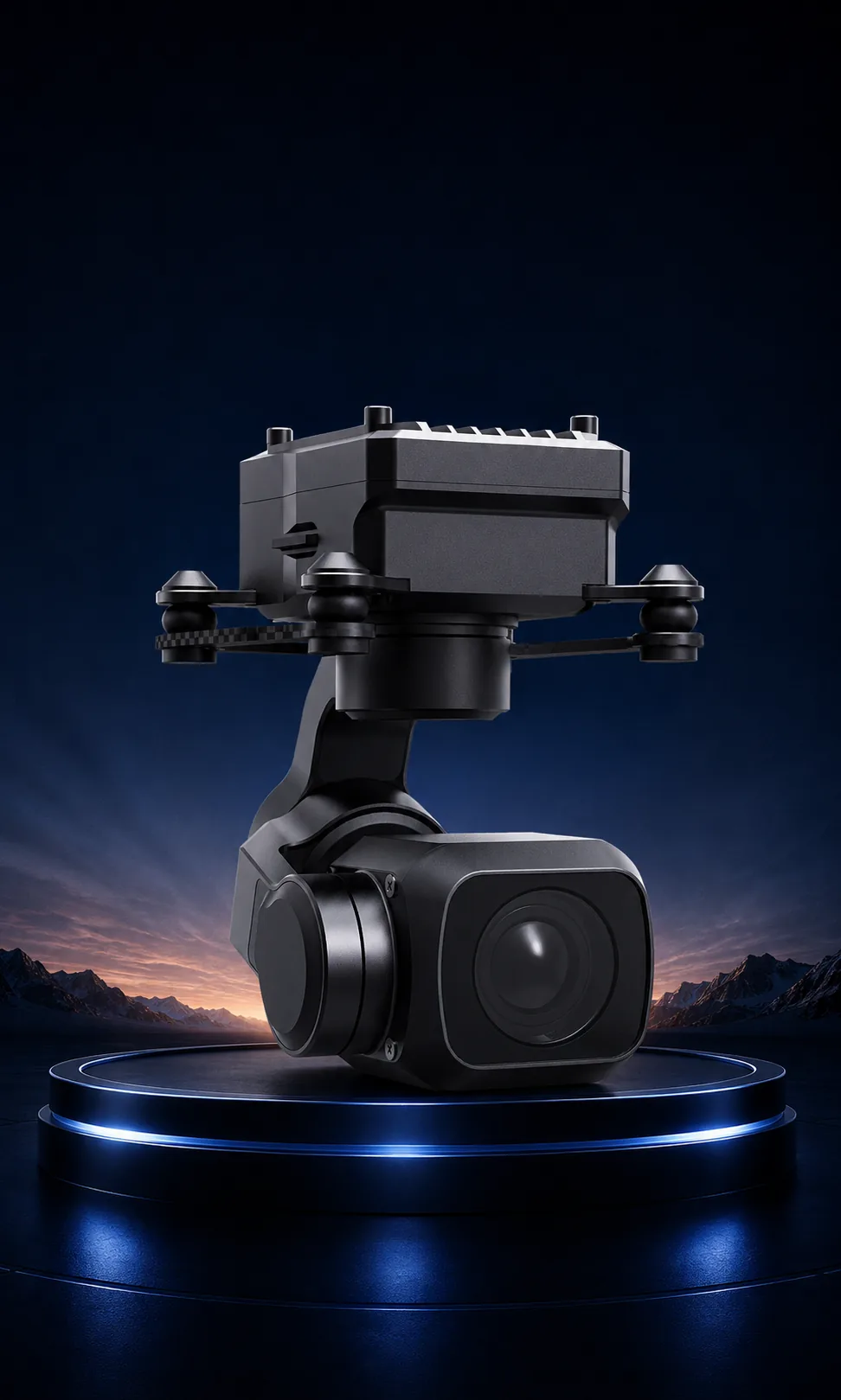
Multi-sensor payloads like the MV-4X — starlight, 640×512 thermal and NIR in one micro pod — and the OP-80N exist for exactly this loop. The channels being in one boresight-aligned housing is what makes the slew-and-identify step fast enough to matter; two separate cameras cannot hand off between each other.
Police work treats dual-sensor as an officer-safety requirement rather than a preference, because identification before approach is what the accountability standard demands. Dual-channel display modes covers presenting both without mode-surfing at the critical moment, and AI tracking covers holding the subject across the handoff.
What the Published Numbers Say
The low-light side has concrete figures worth knowing, because “night vision” covers a very wide range of actual sensitivity.
| Payload | Published minimum illumination | Thermal |
|---|---|---|
| OP-80P | 0.001 lux at f/1.5, night vision on | — |
| OP-80A | 0.0015 lux at f/1.6, night vision on | — |
| OP-90D | 0.0015 lux at f/1.6, night vision on | — |
| OP-90A | 0.0015 lux at f/1.6, night vision on | 640×512, <50 mK |
| MV-2P | — | 640×512, <40 mK |
A figure of 0.001 lux is far below usable human vision, but it is not zero — and zero is exactly what you get inside a structure or under heavy canopy on a moonless night. That floor is why NIR illumination exists as a third option, and why thermal remains the only channel with no illumination dependency at all.
Which to Buy First
For an agency or operator who cannot yet afford both, the sequence follows the mission rather than the technology.
If the mission is finding people — search and rescue, missing persons, suspect containment — thermal first. Detection is the harder problem and thermal is the only reliable solution to it after dark.
If the mission is documenting activity — evidence collection, monitoring a known location, recording what happened — starlight first, because the deliverable is identifiable detail and thermal cannot supply it.
Budget for the dual-sensor payload if night work is core to the programme. The intermediate step of buying one now and the other later is usually more expensive than buying a combined pod once, because it means two integrations and two spares inventories — one multi-sensor payload or several cameras works through that arithmetic, and building a public safety programme covers the staging.
Related reading
- Starlight and Low-Light Imaging
- NIR Laser Illumination
- Starlight vs NIR vs Thermal: The Three-Technology Guide
- Why Thermal Cameras Live at 8–14 µm
- Thermal Drones in Law Enforcement
- One Multi-Sensor Payload or Several Cameras?
- PiP, Fusion and Split View
- DRI Ranges Explained
- MV-4X — starlight, thermal and NIR
- OP-80N — starlight and NIR identification
- OP-90A — low-light zoom plus thermal
- Night Security Patrol Drones
FAQ
Is a colour night image always better than thermal?
For identification yes, for detection no. Camouflage, shadow and cover defeat visible-spectrum sensors but not body heat, so a subject who is effectively invisible to a starlight camera can be obvious in thermal. The colour image is better once you know where to look; thermal is what tells you where to look. Treating one as strictly superior is the most common night-payload specification error.
Which should a small agency buy first?
If the mission is finding people, thermal first — detection after dark is the harder problem and thermal is the only reliable answer. If the mission is documenting activity, starlight first, because the deliverable is identifiable detail that thermal cannot produce. If night work is core to the programme, budget for a dual-sensor payload directly; buying one then the other usually costs more in duplicated integration and spares.
Does thermal work better than night vision in fog?
It degrades least, which is not the same as working well. Long-wave infrared is scattered less by small water droplets than visible light, so thermal retains usable range in conditions where a starlight sensor is struggling. NIR illumination fares worst of the three because its own beam backscatters off the droplets into the sensor. In dense fog all three lose substantial range and planning should assume it.
Questions about the technology? Talk to our engineers — we reply within 2 business days.